
A five-point AI framework for sensory science practitioners
From Section 9 of “From Measurement to Meaning”: a practical framework for sensory scientists navigating the AI era without surrendering their expertise.
By John Ennis, PhD, Aigora
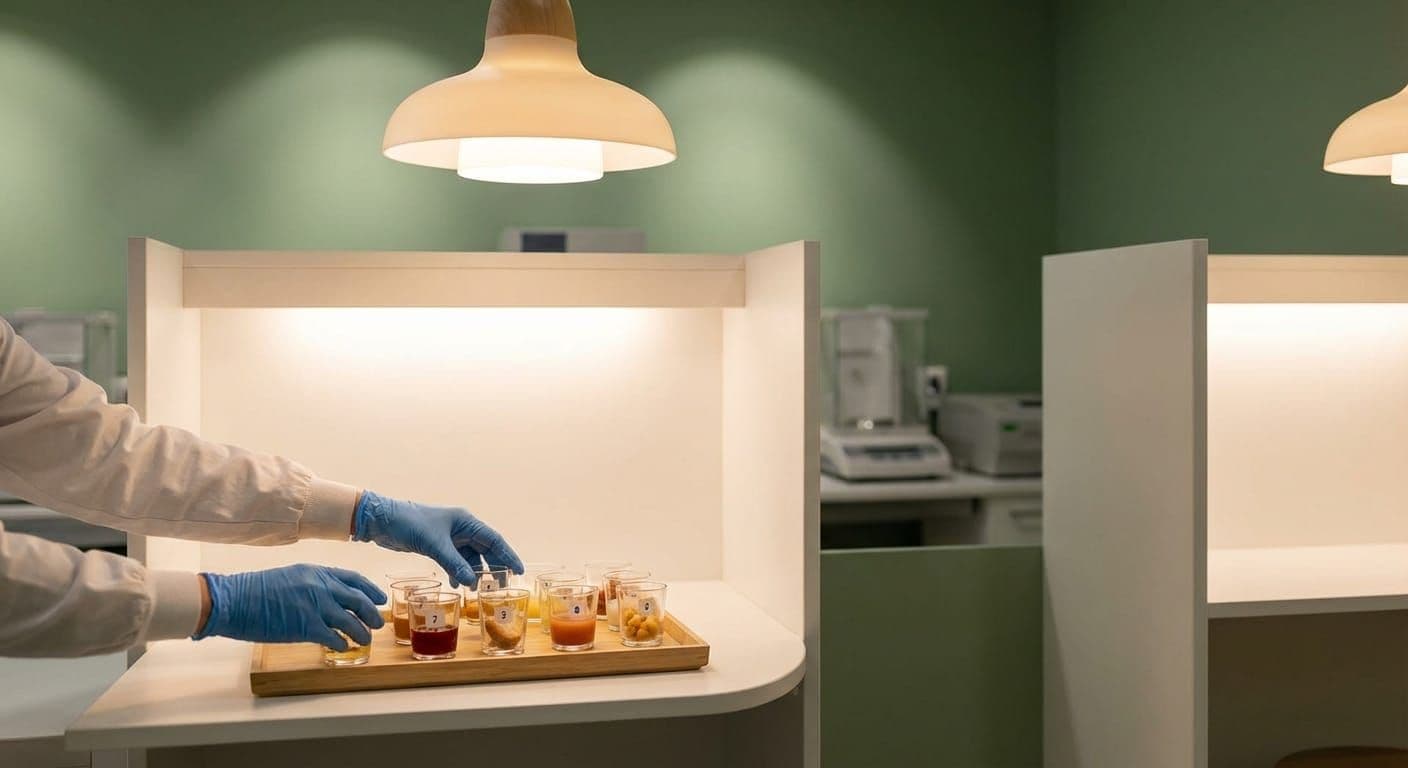
The previous sections of this guide have established a clear picture: AI is a powerful amplifier of sensory science, not a replacement. But how should a working practitioner (someone running panels, designing formulations, or interpreting consumer data) actually work in this new environment? Dr. Ennis distills the guide's insights into five actionable principles.
Reassert domain authority
Your expertise is the irreplaceable differentiator
You are the expert on human perception. Use AI to widen the search, not to narrow your role.
What this means in practice
As AI automates routine analytical tasks (clustering, prediction, screening) the bottleneck in sensory science shifts from measurement to meaning. Models can correlate; you must decide what is worth optimizing, in which contexts, for whom, and with what trade-offs. That is a human task grounded in embodiment, culture, and ethics.
Moravec's paradox reminds us that what is hard for machines (sensorimotor nuance) is often what evolution made easy for humans. The uniquely human contributions of cultural interpretation and meaning-making are the irreducible differentiator. AI is gaining genuine physical intuition, which makes it a more powerful partner for modeling perception, but it remains without a first-person point of view, which makes your judgment irreplaceable for meaning and ethics.
Be a data skeptic
Garbage in, gospel out is the new danger
Curate training data; probe bias, coverage, and drift. Garbage in, gospel out is the new danger.
What this means in practice
AI outputs appear authoritative and fluent, which makes them easy to accept uncritically. The traditional “garbage in, garbage out” has evolved: now it is “garbage in, gospel out”; because the model's polished delivery can mask fundamentally flawed inputs. Every response generated by a large language model is, in a sense, a remix of its training corpus; not a neutral database but a tangle of biases, obsolete ideologies, and cultural ephemera compressed into parameter weights.
Digital sensing systems also face unique challenges. Sensor drift from temperature and humidity requires frequent recalibration; maintenance costs can reach 30% of initial hardware cost annually. Data sheets should document sources, representativeness, known gaps, and explicit handling of perceptual minorities: anosmias, super-tasters, trigeminal sensitivities.
Sensory scientists should be alert to the fact that LLM fluency can mask distributional drift; the model is remixing the archive, not encountering the world anew.
Insist on interpretability
If it can't show its work, it isn't a scientific instrument
If it can't show its work, it isn't a scientific instrument.
What this means in practice
If a model informs a decision, it should expose drivers, counterfactuals, and uncertainty. An interpretability pack should include: drivers of the prediction, localized effects, counterfactual scenarios (what would change if input X were different?), and an error taxonomy classifying the types and severities of potential failures.
In the amplifier era, the useful output is a distribution you can decide with, not a point estimate. If credible intervals overlap accept/reject bands, route to panel. Sensory AI should be governed as carefully as any lab instrument, with intended-use statements, drift monitors, and human stop-rules that automatically trigger panel or consumer re-checks.
As of September 28, 2026, the EU AI Act applies with phased exceptions. Transparency obligations took effect on August 2, 2026. The AI Omnibus entered into force on July 27, 2026 and moved the high-risk rules to December 2, 2027 for Annex III systems and August 2, 2028 for systems embedded in Annex I products. Assess each sensory research system against the Act’s intended-use and risk criteria; using physiological data alone is not a complete risk classification.
Keep humans in the loop
Panels, ethnography, and expert judgment get sharper
Panels, ethnography, and expert judgment don't go away; they get sharper and more targeted.
What this means in practice
End-to-end “AI-only” systems stumble in messy contexts. High correlation is not comprehension. Demos are not deployments. The lesson is consistent: AI is a potent partner when humans remain firmly in the loop.
The comparison between human panels, GC-MS analysis, and AI-powered e-noses and e-tongues remains nuanced: human panels offer extreme sensitivity and contextual judgment; GC-MS delivers objective but slow laboratory analysis; AI-powered digital sensors provide real-time, low-cost objectivity but with variable sensitivity. The three approaches are complementary, not interchangeable.
Biometric sensors (galvanic skin response, heart-rate variability, and EEG) add a physiological layer to the expert's interpretive judgment. These approaches do not replace panels; they sharpen them. The future is AI-elevated sensory science: models do the combinatorics; humans do the sense-making.
Track the edge
Pilot emerging technologies now to understand their affordances
Pilot neuromorphic sensors, event-based data, and embodied evaluation setups now to understand their affordances.
What this means in practice
Neuromorphic hardware has advanced rapidly toward commercial scale. Intel's Hala Point system (packaging 1,152 Loihi 2 processors, 1.15 billion neurons, and 128 billion synapses) delivers 20 petaops at up to 15 TOPS/W by exploiting event-driven processing where neurons consume power only when they spike. SynSense's Speck 2.0 integrates a dynamic vision sensor and spiking neural network on a single chip at under 5 mW and a projected cost below $7 per unit.
High-density tactile systems (XELA Robotics' uSkin (3-axis, 2.5 mm spatial resolution), Ensuring Technology's Tacta (361 sensels/cm² at 1000 Hz), and neuromorphic electronic skin with active pain and reflex arcs) open a new frontier for sensory science. Texture, mouthfeel, and haptic product qualities that have traditionally required human panels may soon be characterized by robotic systems with superhuman spatial and temporal resolution.
The neuromorphic computing market reached approximately $9 billion in 2025, with a projected CAGR exceeding 50% through 2034. For sensory science, these chips offer a path to always-on, milliwatt-level chemical and tactile sensing at the point of use, fundamentally changing how and where data can be collected.
This page presents Section 9 of “From Measurement to Meaning: Why AI Makes Sensory Science More Essential” by John M. Ennis, PhD, with contextual guidance drawn from the full article. The original text is rendered in full above.
Continue reading
Back to the science guideLet's talk about what AI can do for your team
Upgrade your sensory research with AI-powered tools built by domain experts.