The evolution of sensory science from a qualitative practice to a rigorous quantitative discipline is anchored in psychological measurement theories that account for the inherent variability of human perception. At the heart of this transformation is Thurstonian modeling—a framework that treats sensory experience not as a fixed value, but as a stochastic process.
For years, sensory scientists have relied on Signal Detection Theory (SDT) to derive invariant measures of sensory difference, most notably the d-prime statistic. However, as the industry moves toward AI-enhanced workflows and digital transformation, the tools we use to calculate these metrics must evolve. This is why we developed sensPy: a comprehensive Python port of the industry-standard R package, sensR.
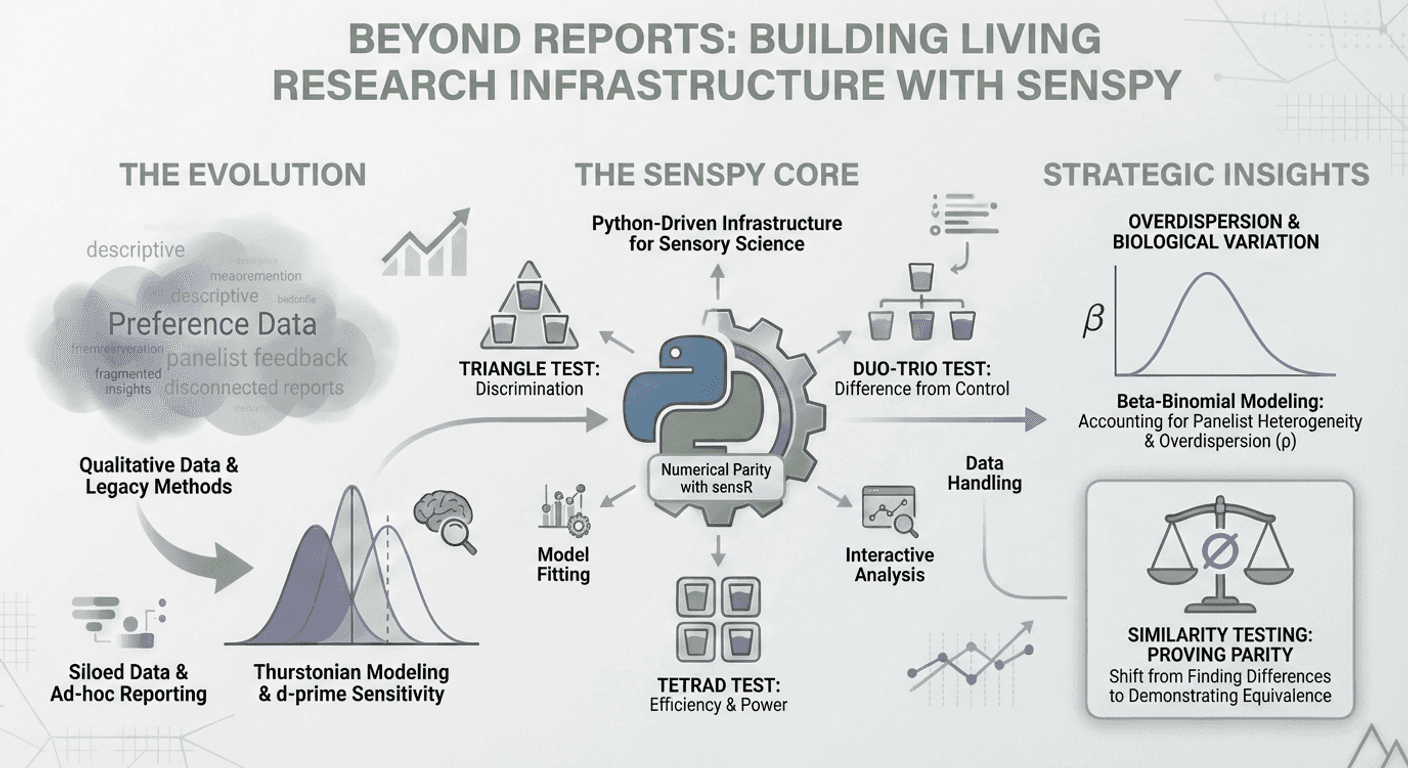
In modern sensometrics, d-prime is a powerful parameter because it represents the number of standard deviations separating two perceived distributions, such as noise versus signal. Its primary value lies in its theoretical independence from the specific test method used. Whether an assessor performs a Triangle, Duo-Trio, or 2-AFC test, their underlying sensory sensitivity should remain constant, provided the cognitive load is comparable.
However, many sensory teams are trapped in a cycle of one off vendor reports and fragmented systems. This reactive mode prevents learning from compounding and makes it difficult to justify investments in sensory science at the executive level. To shift from reactive insights to strategic leadership, sensory functions need infrastructure tools that allow them to build, validate, and scale their own methodologies within a modern data ecosystem.
sensPy was developed to provide numerical parity with sensR while integrating seamlessly with modern Python practices. It is designed for the sensory scientist who values intellectual rigor and the technical gatekeeper who demands clean, documented architecture.
sensPy automates the complex numerical integration required for Thurstonian analysis across all standard protocols, including single and double variants. This includes Triangle and Duo-Trio tests, which are essential for identifying overall differences without prior attribute knowledge, as well as 2-AFC and 3-AFC directional tasks that reduce internal decision noise and offer higher statistical power. It also supports advanced protocols like Tetrad and Hexad for increased efficiency in large-scale testing.
Standard binomial analysis often fails in the real world because it assumes every trial is independent and every panelist has identical sensitivity. In reality, biological variation and trial correlation often caused by fatigue or learning lead to overdispersion. sensPy implements the Beta binomial model, the standard sensometric solution for overdispersed data. By accounting for the intra class correlation, sensPy ensures that p-values are not artificially small and confidence intervals are not too narrow, protecting your team from false positives.
A common strategic objective in product reformulation, such as sugar reduction, is ensuring consumers cannot perceive a change. This requires a Similarity Test, which reverses the traditional null hypothesis. sensPy provides the computational power to conduct these high-stakes tests, allowing you to define a similarity threshold and demonstrate with statistical confidence that a new formula is perceptually indistinguishable from the gold standard.
The library is designed to be both authoritative and accessible. Using the system is straightforward: a scientist can input the number of correct responses and total trials into a discrimination function, specifying the method to receive a calculated d-prime, confidence intervals, and p-values immediately. Furthermore, the tool allows for power analysis, enabling teams to determine the exact sample size needed for future tests based on a target d-prime.
By moving your modeling into the Python ecosystem with sensPy, you are not just running a test, you are building insight infrastructure. We do not just deliver tools; we empower sensory and consumer science teams to lead. Whether you are a Global Sensory Lead looking to maintain methodological rigor or a Director of Innovation looking to accelerate time to insight, sensPy provides the scientific validation you need to innovate with confidence.
Thurstone, L. L. (1927). A law of comparative judgment. Psychological Review.
Brockhoff, P. B., & Christensen, R. H. B. (2025). sensR: Thurstonian Models for Sensory Discrimination.
ISO 8586:2023. Sensory analysis — Selection and training of sensory assessors.
ASTM E1885 - 18. Standard Test Method for Sensory Analysis—Triangle Test.
Aigora (2025). sensPy: Python port of sensR for Thurstonian models. https://github.com/aigorahub/sensPy
Aigora is a contributor to the Aigora blog, sharing insights on AI-powered sensory science and product development.
Tell us what your team is working on through our contact form. We'll review your request and reply within one business day.