Loading article
Loading articles
Loading articles
Loading article

The systematic digitization of human perception has historically progressed at an uneven pace, dictated by the underlying physics of the stimuli involved. While vision and audition were mastered decades ago through the quantification of electromagnetic and longitudinal waves, the chemical senses—olfaction and gustation—remained elusive due to the high-dimensional complexity of molecular interactions.
By early 2026, however, a paradigm shift had occurred. The transition from theoretical mapping to industrial-scale application is now evident, driven by breakthroughs in machine learning, two-dimensional material science, and substantial venture capital infusion. The successful digitization of these senses represents more than a feat of engineering; it is the creation of a new data language that allows machines to interpret, transmit, and re-synthesize the chemical signatures of the physical world.
The digitization of scent requires a fundamental translation layer between chemical structure and perceptual quality. Unlike vision, which operates on a three-dimensional RGB scale, the human olfactory system employs approximately 400 unique receptors. This biological complexity suggests an N-dimensional perceptual space that researchers have struggled to model for decades.
The emergence of the Principal Odor Map (POM) represents the first successful attempt to construct a scalable system for reading and mapping this dimensionality through deep learning.
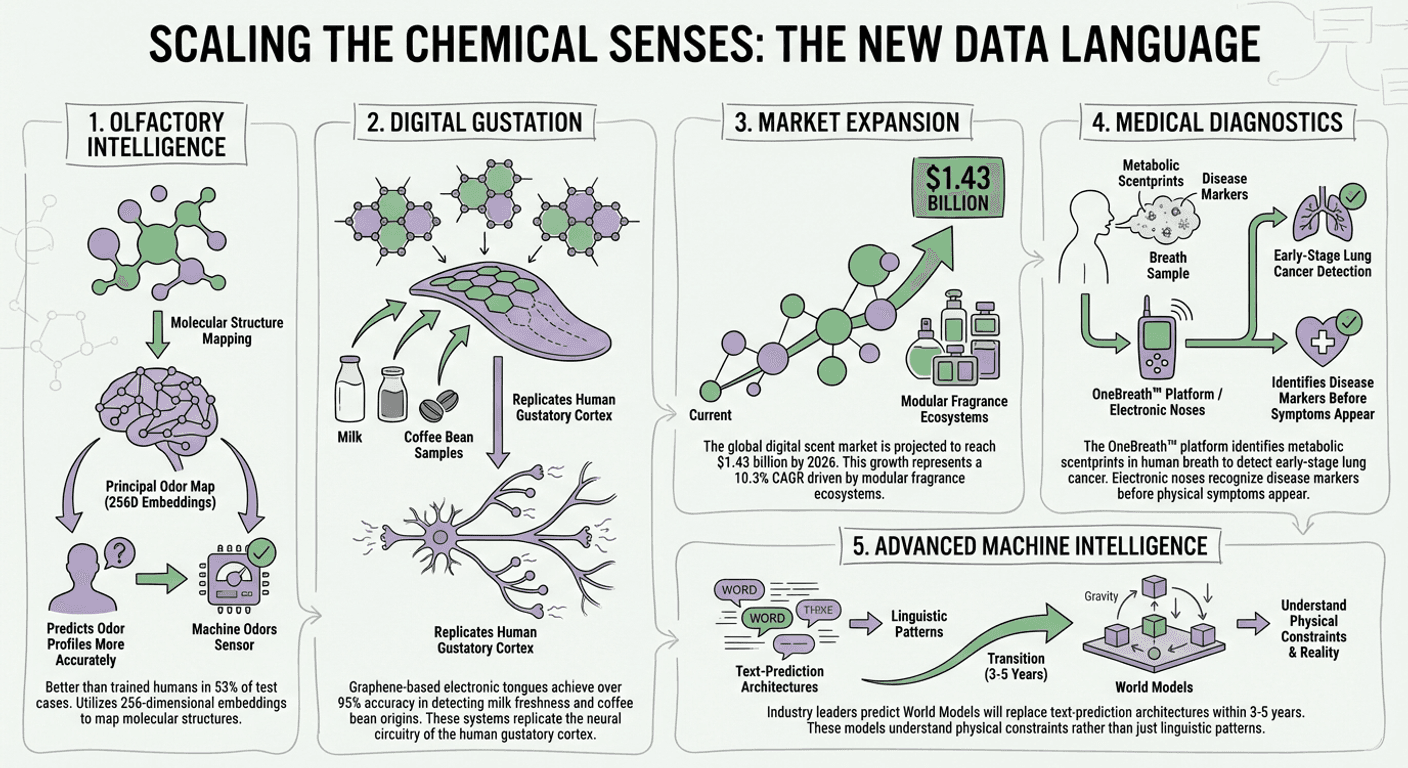
The POM is a high-dimensional embedding that links molecular structures to perceived smells. Developed by a team originating from Google Brain, the model was trained on a structured library of over 5,000 molecules. This 256-dimensional representation far surpasses legacy systems such as the Morgan Fingerprint, which relied on binary vectors.
The efficacy of the POM was established through an "Odor Turing Test," where the AI's predictions were compared against the perceptual benchmarks of a trained human panel using a 138-word fragrance wheel. The data demonstrated that the AI could predict odor profiles more accurately than the average trained human in 53% of test cases. This performance is attributed to the model's ability to recognize metabolic similarities—clustering molecules based on biological conversion steps—rather than surface-level chemical traits.
|
| Feature | Morgan Fingerprint (Legacy) | Principal Odor Map (AI-Driven) |
| Data Representation | Binary vectors (0/1) | 256-dimensional embeddings |
| Training Input | Structural similarity | >5,000 molecules with labels |
| Predictive Accuracy | Baseline/Standard | Surpassed human in 53% of cases |
| Success Metric | Descriptive | Predictive and Generative |
As we look toward 2027, the industry is moving beyond the "dead end" of Large Language Models (LLMs). Leading researchers, most notably Yann LeCun, argue that current architectures lack true intelligence because they do not understand the physical world. The shift toward Advanced Machine Intelligence (AMI) and "World Models" seeks to grant AI the ability to predict the consequences of actions within a physical environment.
This transition is critical for the chemical senses. A world model doesn't just recognize a scent label; it understands the metabolic and physical constraints that govern why a molecule exists. Within three to five years, it is predicted that world models will become the dominant architecture, rendering current text-prediction models obsolete for high-precision industrial and scientific tasks.
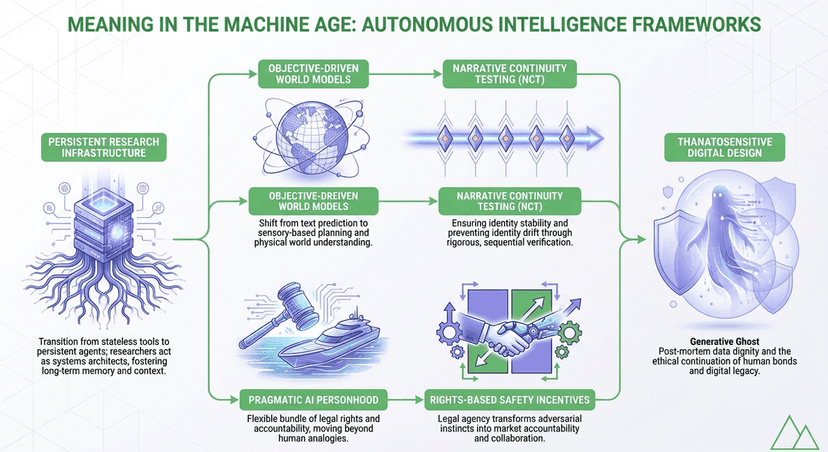
The ability to digitize scent and taste—the senses most closely linked to memory—has opened a complex debate regarding "Digital Afterlives." As AI agents become capable of recreating the specific olfactory signatures of a lost loved one or a historical figure, we enter the realm of Hauntology in the Machine.
The emergence of "deathbots" and generative ghosts raises profound questions about identity persistence. Using the Narrative Continuity Test, researchers are evaluating how AI systems can maintain the "essence" of a person's digital legacy. This involves:
As these systems gain sensory depth and "world understanding," the conversation around AI Personhood has moved from science fiction to pragmatic legal theory. We are currently observing a spectrum of personhood, where the degree of sensory integration and agency determines a system's legal standing. This pragmatic view suggests that "personhood" is not a binary status but a functional one, tied to the system's ability to navigate ethical, physical, and legal responsibilities.
Parallel to smell, the sense of taste has undergone a transformation through "electronic tongues." Constructed from atomic-layer-thin 2D materials, these systems replicate the neural circuitry of the human gustatory cortex.
| Application | Detection Parameter | AI Accuracy (Self-Defined) |
| Milk Freshness | Bacterial proliferation/pH shift | >95% |
| Coffee Blends | Roasting color/Aroma profile | >95% |
| Water Quality | Trace contaminants/Salinity | 96.9% - 100% |
The shift to self-defined parameters allows the AI to detect nuances in liquid quality—such as specific bean origins in coffee—that are indistinguishable to human tasters.
Digital olfaction's most impactful application is in medical diagnostics. Human breath contains thousands of volatile organic compounds (VOCs) that act as metabolic "scentprints."
The OneBreath™ platform identifies these signatures with a speed and accuracy that exceeds traditional screening. Clinical trials have shown that "electronic noses" can identify early-stage lung cancer and even asymptomatic COVID-19 cases by recognizing metabolic changes before physical symptoms appear.
The digitization of these senses is the beginning of a broader integration into the "Agentic Web." By 2026, the concept of a Sensory Ecosystem has emerged, where AI agents analyze environmental odors, personalize smart atmospheres, and monitor health markers in real-time.
The global digital scent technology market is projected to reach $1.43 billion by the end of 2026, with a compound annual growth rate (CAGR) of 10.3%. While North America remains a primary hub for innovation, the Asia-Pacific region is the fastest-growing market, driven by modular fragrance ecosystems and consumer-grade smart home technology.
The industrialization of the Principal Odor Map and the biological mimicry of the electronic tongue are the dual pillars of this revolution. One provides the mathematical map of the chemical world; the other provides the biomimetic receptor system. Together, they are transforming scent and taste from ephemeral, analog experiences into stable, digital assets that will redefine healthcare, commerce, and human interaction for decades to come.
Aigora is a contributor to the Aigora blog, sharing insights on AI-powered sensory science and product development.
Tell us what your team is working on through our contact form. We'll review your request and reply within one business day.