AI Expertise for Consumer Insights

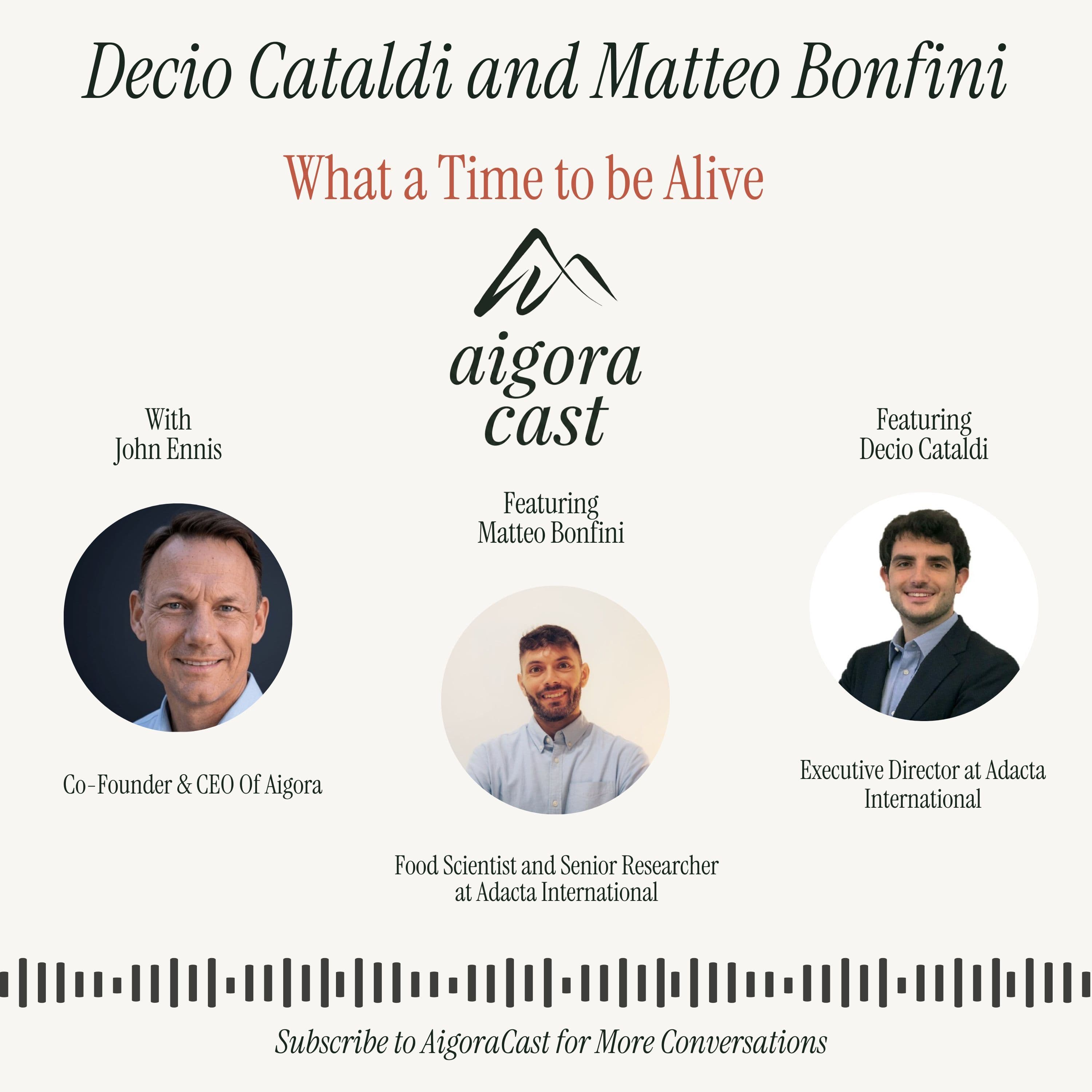
Episode Title: What a Time to Be Alive – AI in Sensory & Consumer Science
Host: John Ennis
Guests: Decio Cataldi (Executive Director) & Matteo Bonfini (Food Scientist/Senior Researcher) – Adacta International
AigoraCast Episode What a Time to be Alive, a conversation with
Matteo Bonfini and Decio Cataldi is now live!
Visit your favorite platform and remember to subscribe:
Please leave a positive review if you like what you hear!
Welcome to AigoraCast, where we explore how new technologies are impacting sensory and consumer science. In this episode, host John Ennis speaks with Decio Cataldi, Executive Director, and Matteo Bonfini, Food Scientist and Senior Researcher, both from Adacta International. From the historic "Food Valley" of Parma to the digital frontiers of conversational AI, our guests discuss how Adacta is reshaping consumer research, the democratization of data, and why the "human experience" remains irreplaceable.
Voiceover: Welcome to AigoraCast! Conversations with industry experts on how new technologies are impacting sensory and consumer science.
John: Okay, welcome back everyone to another episode of AigoraCast. Today, I'm very happy to have Decio Cataldi and Matteo Bonfini from Adacta International on the show. Decio Cataldi is the executive director at Adacta International, a leader in consumer and sensory research. In his role, Decio oversees the company's strategic and financial direction with a specific focus on driving growth through technological innovation. With a background in strategy consulting, M&A, and restructuring, he brings analytic rigor to the field, spearheading Adacta's efforts to integrate AI into sensory and consumer science to create more predictive, data-driven research models.
Meanwhile, Matteo Bonfini is a food scientist and senior researcher at Adacta International where he leads sensory and consumer science projects for major global CPG companies. Matteo specializes in decoding consumer perception across diverse international markets, translating deep sensory data into actionable strategies for product innovation. He's dedicated to exploring how emerging technologies can enhance traditional methodologies and push the boundaries of consumer research. So, Decio and Matteo, welcome to the show.
Decio: Hi John, and thank you very much for having us. I'm thrilled for this episode.
John: Yeah, it's great. And I'm glad I made it through the very long double introduction with two Italian names. That was a little nerve-wracking for me, but I made it, so now we can get started. So, Decio, maybe you can start by telling us a little bit about Adacta and how it is you guys got to where you are, what motivated you, and what your journey was to getting to this point.
Decio: Yeah, of course. I'll try to be as short as possible. I'm very happy and thrilled actually to tell this story because Adacta International is actually a family business, and I have the honor to be the son of the founders of the company. So I'm the second generation, with all that it means. My background, just to be short about it, I am a Chief Public Accountant. I think it's said in English, so it's a finance background, as you said before. But after several years in consulting, I finally decided to join the family business. A family business that was actually founded in 1992. I usually say that Adacta is my elder sister because I was born in 1995. So, you know, we grew up together and this is quite fun. I'm the only child, so actually, it's exactly the way it was.
In 1992 it was quite different from what it is today because it was basically a data collection and fieldwork agency. It actually moved to consumer and sensory, I would say in 2001, so the beginning of the 21st century. Because we developed the consumer and sensory unit. And this was a very, very important change and an important milestone, I would say, because it shaped what we are today. In 2001, we developed a team of statisticians and chemists, food technologists, psychologists, and economists that made us what we are today and made us leaders, at least in Italy, in consumer and sensory science.
So today, I'd like to say that we have two souls. There is one analytic soul and another is more a kind of market research soul. The analytic soul talks to R&D and quality of our clients, whereas the market research soul talks to marketing. And what I think is one of our peculiarities is that we mix these skills together. We became basically consumer and sensory consultants at the end of the day. Today we can say that we've run more than 1 million and 6,000 interviews in 32 years of history, and we have tested over 25,000 products. So, I hope this was a short story, but it gives you some highlights of what we are and what we have been, and maybe later we will see what we will be.
John: Oh, very interesting. Okay. And Matteo, maybe you can talk about how it is you came to be here at Adacta, what your journey was, and what your role is now.
Matteo: Yeah. I'm a food scientist. So my background is totally in line with the chemical, physical part of the product. I'm really passionate about the relationship between product and customers. So, you know, John, in Italy, we have a quite specific relation with food. We love our food, we love our production, and I live this relationship with food. I started to follow my passion by choosing a university that is based in Parma. I don't know if you know where Parma is in the Italian territory, but we call it the "Food Valley" because it's based in the central-north part of Italy, and it's surrounded by the biggest productions of our country. Just a few names: Parmigiano-Reggiano—so the Parmesan—balsamic vinegar, and some specific productions. I started focusing on the product.
But when I encountered sensory science and this discipline that is evolving, that is contaminated by psychology, neuroscience, and also anthropology at some level, I developed this deep passion for sensory and consumer science. So I hybridized my passion for food with the passion for sensory science. This also took me to develop my knowledge in other territories that are not only about food, like home care products and personal care products.
At Adacta, we call our researchers "product coaches." We link our passion for the product, whether food or personal care, to our passion for sensory science. So if I need to say what am I now, I'm a product coach. A person that is passionate about sensory science and that wants to develop products in line with consumer expectations.
John: Yeah, I mean I think that, and part of why we're here today is because, you know, I wrote my article on AI and the future of sensory, from measurement to meaning. I think you had a chance to read that. I wanted to write part two, which is the state of practice. Part one was based on our experience and publicly available information, published articles, press releases, that kind of thing. But I wanted to learn what it is like in practice. How is it that you all are leveraging this now? Because I think what you said, Matteo, is really correct. In sensory science, we study the experience of life. I think one of the great things about being human is eating delicious food, right? That's something a machine can't understand. What does it feel like to be sitting in Tuscany, drinking Italian wine, and eating cheeses? A machine will never understand it. It's kind of sad for the machines, but they'll never get to understand what that feels like. So they can help us to understand it, but they can't understand it themselves. Where are you right now in your applications of machine learning, statistics, and generative models?
Decio: I think Matteo can be more specific than me, so please go on.
Matteo: Thank you, Decio. I will share some applications, and also my expectation about how AI can help us. As I said before, one of the best things about sensory science is that it's very contaminated by other types of science. When technology develops, sensory science develops. In my past, I used, for example, some neuroscience methodology integrated with sensory science. When eye-tracking technology developed, I started to hybridize packaging testing with eye tracking. If you manage sensory projects, you need to pay attention to the evolution of technology because it could help us engage customers in ways that take us to a higher customer intimacy. As sensory scientists, one of the most important things is understanding how to engage customers in the right way to obtain deep sensory data that is linked to reality.
One of the best applications I saw based on AI is using AI to create conversational agents that help us conduct unstructured interviews. These can be integrated with classical quantitative surveys but let the customers talk to the agent in the most natural way possible. In that way, we can understand how people talk about food, how they talk about the user experience of a product, and what type of terms they use in everyday language. We are developing our conversational agent with the possibility to add voice answers, video, and images to have a specific conversation with customers in the real world. This allows us to have a very important amount of data to analyze.
This strategy helps us engage the customer in the way they naturally talk to each other now, using software like WhatsApp or Telegram. They are used to using voice answers and so on. We give the customer the possibility to act as in a normal daily conversation focusing on what is important for us in research, for example, the user experience of a product. And this is the first pillar of how we use AI.
John: Yeah. Okay, that's a lot in there to talk about. So maybe just Decio, did you want to add anything before we go on? Because you've seen the whole evolution here starting from your early life, how the company has changed. Maybe you can talk about the changes you've seen?
Decio: Yes. I mean, what comes to my mind is "what a time to be alive." When the company was born, nobody could ever imagine twenty years of artificial intelligence, or agentic symbiosis and so on in consumer science. So I find it extremely difficult to keep in touch with all this speed...
John: No, I can completely relate to that. If I don't have agents running right now, I feel anxious, like I'm wasting opportunities. When I started my career in 1994, I was writing Fortran code for my father, and in those days data was collected on physical disks and literally mailed in the postal system. You'd get the disk, run the analysis, and mail the disk back. And now we have all of this happening instantaneously. It's just incredible speed and bandwidth.
Matteo: Yeah, there is another aspect that I want to deepen. Normally, as sensory scientists, we consider ourselves quantitative data analysts. We need to reshape the way in which we consider the data we obtain. We need to integrate qualitative and quantitative data.
John: Oh yeah, 100%. I've been talking since we started Aigora in 2019 that quant and qualitative data would come together. There have been huge advances lately with scoring systems. Like the semantic similarity rating that came out of PiMac Labs—Thomas Vici talked about that on the show. And work we've done with Thierry Worch and Benjamin Mathieu scoring ideal and actual descriptions of ham. Interestingly, if you take a non-thinking model like Gemini Flash Lite, it actually scores better than models with thinking. It's like the "gut reaction" for a human is closer to what we're trying to measure, and thinking hurts the models when it comes to scoring.
Matteo: The most important aspect is the way in which AI can reshape the report. We can now create reports that are quantitative but have some qualitative shade. We can translate these numbers into text and summaries. This leads to a democratization of sensory data. Information can flow up to management and decision-makers so they can see the impact of their decisions without needing to understand what a principal component analysis is or having to read complex histograms.
John: Yes. Okay, I totally agree with that. Decio, I know you had something to add about this? I completely agree that AI can really help us with communication. Decio please.
Decio: Just a general consideration. AI is not a trend; it is something that will be forever in the market research industry. But what I think is very important now is not following the rush. People are rushing for innovation just to say they use AI. We need to make it systematic and build actual workflows. Another aspect that won't ever be substituted by AI is doing tests physically. Managing physical spaces like Central Location Tests (CLT) will remain core skills because you have to capture authentic human data.
John: Yeah. I definitely agree that you have to be intentional in your use of AI. It's easy to go on "side quests" just because something is cool. There's a fear of it taking jobs, but actually, I feel more free and more alive. It's automating all the stuff I didn't want to do anyway, leaving us free to do the important syntheses. But we are amazingly almost at time, so we have to get some final thoughts.
Matteo: My final thought is I totally agree with you that AI can give us the fuel for the future to renovate the passion for this discipline. This is my final thought.
Decio: And yeah, I repeat what I said before. What a time to be alive. Nothing gets destroyed; new jobs are created. It's an incredible opportunity we have to experience this innovation.
John: Yes. I think we're going to go with "What a time to be alive" as the show title. That is a really good note to end on. Okay, so if people want to get in touch with you, what are the best ways to connect with you either individually or with Adacta?
Matteo: LinkedIn is great, or our website at adactainternational.com. For emails, mine is matteo.bonfini@adactainternational.com.
Decio: And mine is d.cataldi@adactainternational.com.
John: We'll put that in the show notes. Alright guys, well thanks a lot, this has been a real pleasure.
Matteo: Thank you very much, John. Our pleasure. Thank you. Grazie mille. Perfect.
John: Okay, that's it. Hope you enjoyed this conversation. If you did, please help us grow our audience by telling a friend about AigoraCast and leaving us a positive review on iTunes. And, if you'd like to learn more about Aigora, please visit us at www.aigora.com. Thanks!
AigoraCast: Conversations with industry experts on how new technologies are impacting sensory and consumer science.
AigoraCast Episode What a Time to be Alive, a conversation with
Matteo Bonfini and Decio Cataldi is now live!
Visit your favorite platform and remember to subscribe:
Please leave a positive review if you like what you hear!
Aigora is a contributor to the Aigora blog, sharing insights on AI-powered sensory science and product development.
Anshul Dubey joins John Ennis to discuss practical AI adoption, helping skeptical teams, and using AI as a coach to strengthen human thinking and skills.
Hank Margolis joins AigoraCast to discuss building Zevia, improving formulations, earning trust, and staying open to changes in the beverage market.
Welcome to AigoraCast. Conversations with industry experts on how new technologies are impacting sensory and consumer science.
Tell us what your team is working on through our contact form. We'll review your request and reply within one business day.