
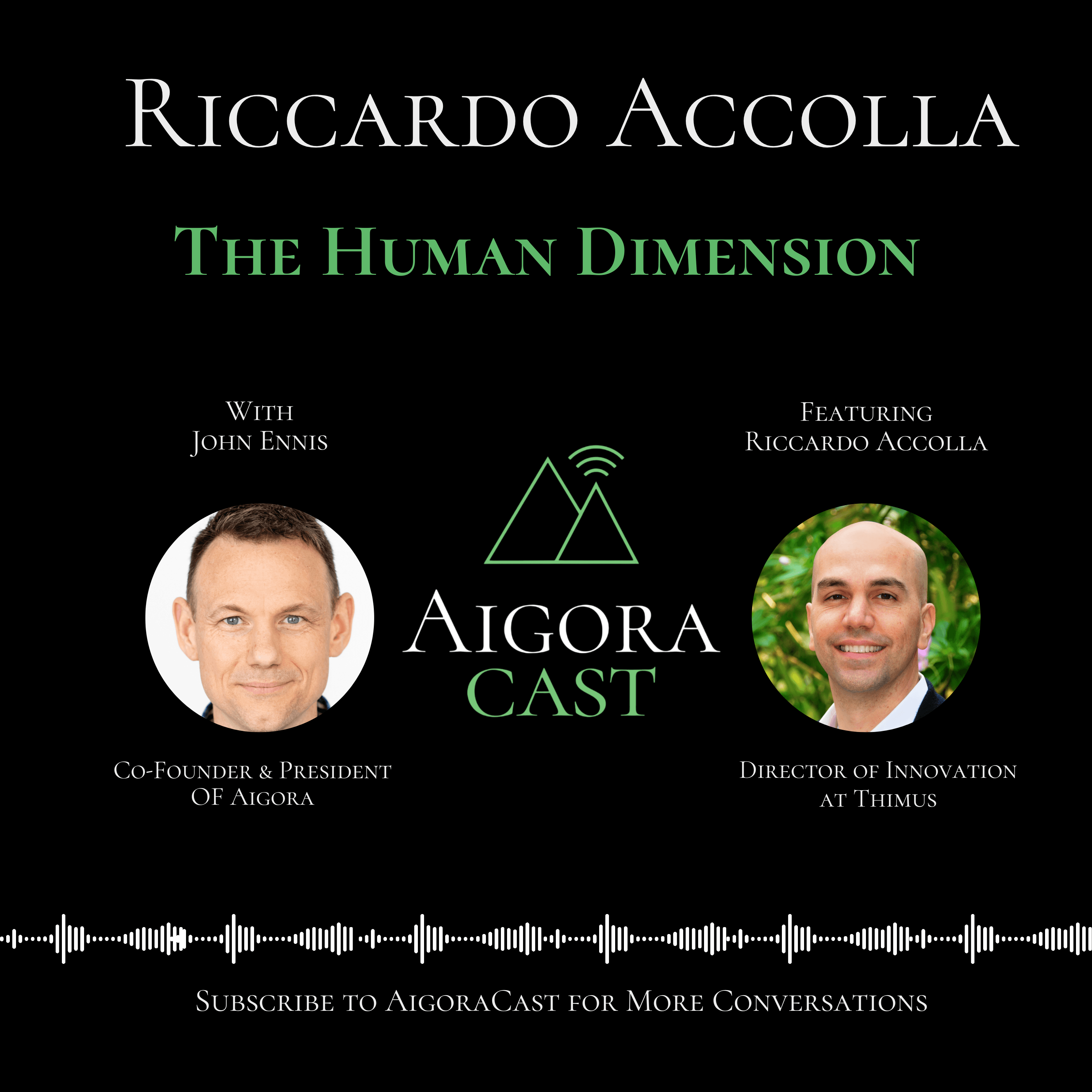
Hi, I’m Dr. John Ennis, CEO at Aigora. In this episode, I had a very pleasant conversation with Dr. Riccardo Accolla, Director of Innovation at Thimus. I just recently met Riccardo, but he is a kindred spirit for sure. I particularly enjoyed our talk about his work using EEG to track emotional responses to food. He also had some great insights into why Beyond Meat’s early products missed the mark with consumers. I hope you enjoy this conversation as much as I did, and remember to subscribe to AigoraCast to hear more conversations like this one in the future!
Dr. Riccardo Accolla is a neuroscientist and food innovation leader dedicated to creating more resilient food systems through technology and human-centric insights. As the Director of Innovation at Thimus, he applies his expertise in multisensory perception, reward, and emotion to develop product strategies that resonate with consumers on a cognitive level.
With over 20 years of experience, Riccardo’s career spans leadership roles at global flavor houses and food-tech startups. He previously led the design of sustainability-tracking software at ripe.io and founded A-T4H Consulting to support "better-for-planet" food solutions. Riccardo holds a PhD in Neuroscience from the Swiss Polytechnic Federal Institute (EPFL) and a Master’s in Biomedical Engineering from the Polytechnic School of Milan.
Remember to subscribe and leave a positive review if you like what you hear!
Announcer: Welcome to AigoraCast, conversations with industry experts on how new technologies are impacting sensory and consumer science.
John Ennis: Hi, I'm Dr. John Ennis, CEO at Aigora. In this episode, I had a very pleasant conversation with Dr. Riccardo Accolla, Director of Innovation at Thimus. I just recently met Riccardo, but he is a kindred spirit for sure. I particularly enjoyed our talk about his work using EEG to track emotional responses to food. He also had some great insights into why Beyond Meat's early products missed the mark with consumers. I hope you enjoy this conversation as much as I did, and remember to subscribe to AigoraCast to hear more conversations like this one in the future. Okay, welcome back everyone to another episode of AigoraCast. Today, I am very happy to have Dr. Riccardo Accolla on the show. So I'll do my best with the pronunciation here, if not being a native Spanish speaker. Well, Dr. Riccardo Accolla is a neuroscientist and food innovation leader dedicated to creating more resilient food systems through technology and human-centric insights. As the Director of Innovation at Thimus, he applies his expertise in multisensory perception, reward, and emotion to develop product strategies that resonate with consumers on a cognitive level. With over 20 years of experience, Riccardo's career spans leadership roles at global flavor houses and food tech startups. He previously led the design of sustainability tracking software at ripe.io and founded AT4H Consulting to support better for planet solutions. Riccardo holds a PhD in neuroscience from the Swiss Polytechnic Federal Institute and a Master's in Biomedical Engineering from the Polytechnic School of Milan. So Riccardo, welcome to the show.
Riccardo Accolla: Thank you, John, for having me. Really excited to be here today.
John Ennis: No, it's great, and we had a really nice conversation before the show. I think you're doing a lot of really innovative work and it was a pleasure to talk to you. So maybe we have a lot in common actually with your background in neuroscience, but maybe you can take us on your career journey to start.
Riccardo Accolla: Yes, yes, sure, sure, actually. So I think I've always been linked to food from my heritage. So I grew up in northeastern Italy, in the middle of vineyards in the Amarone region, so Valpolicella. And I think that kind of impregnated my, started off my passion for sensory and for food in general. The journey really started, my professional journey really started from the very small, so from the physiology of taste. And looking at the small receptors on our tongue and how those are linked to how we perceive different tastes like sugar, sweet, salty, umami, all the way from the tongue to the brain. From there, I went to apply this knowledge to join as a natural step a flavor and fragrances house. I was responsible of innovation, of finding novel ingredients and looking at ways to apply those ingredients in food applications to create flavors and fragrances, mostly on the flavor side, though. After that, and this is where I started to link physiology with, so taste physiology and receptors to the real, to the sensory. So we collaborated with the sensory and consumer insights group and understanding how you can apply, for example, innovation in the sweet receptor sensing to the design of ingredients and flavors that would be then sold to our clients. From there, I went on, you know, when we started looking at the amount of data that was collected within the company on sensory, on receptors, on different types of datasets, I got excited about data. I got excited about the different kinds of data and how they could influence the perception of food we had. And that's why I went to, I kind of jumped ship, I went to work for startups. And as you mentioned, for example, one of these was ripe.io where we digitized the entire chain from the farm all the way to the fork. And I was responsible of creating a predictive model on how, for example, a tomato would taste based on different conditions of growing, different supply chain conditions, transportation, storage, etc. So again, from product innovation to food systems innovation, so to speak, always with a link on sensory. And then I come full circle with Thimus where I actually apply neuroscience, product development, and data and AI to look at emotional responses that consumers have with food. And through that response, together with the declarative response, we provide insights into product development, into product launches, and we serve mostly the food and beverage industry with Thimus. So that's the entire journey, so from the wine of Northeast Italy to kind of go back to an Italian startup, because Thimus is an Italian startup, and applying the knowledge I developed throughout my career.
John Ennis: Yeah, I mean, that's really great. That's just music to my ears because those are the exact things I'm interested in, so that's really great to hear about. So yeah, so you, maybe we can talk about, just to put some anchors in place here. So you were at Firmenich, is that correct, when you were...?
Riccardo Accolla: Actually at Firmenich, one of the major competitors, but yeah, yeah, yeah, yeah. But as a matter of fact, Givaudan is one of our major clients at Thimus, so I am very familiar with the whole industry.
John Ennis: Okay, very good. So you were doing your PhD in basically taste neuroscience, is that right?
Riccardo Accolla: Yes, yes, correct, correct, correct.
John Ennis: And from there you went to Firmenich, and then... So what made you want to go to join a startup? Because I went on my own startup journey, and it was a bit of a wild ride, and it's still going in the background.
Riccardo Accolla: You know, yeah, you start having that seed of being interested in innovation. You know, at Firmenich, beyond the responsibility of taste ingredient innovation, my group had also the role of bringing in new technologies, so scouting and looking at innovators out there from academics to startups. And I remember very vividly one of the first innovation days that we organized actually was part of the committee on selecting the startups, and we invited them one day, they presented to the management, and I happened to join one of those startups that I invited in. Because I saw the potential of innovating within a startup and the fast-paced environment. So there's risk. I've been on a kind of roller coaster over the last 10 years, but there's tremendous reward in terms of getting rid of all the administrative and political stuff that you need to comply with in corporate. And that was, you know, heavy, and I decided, why lose all this time, let's just jump ship. Was that the right decision at the time? It might have been a little early in my career, but I would do the same decision if I had to.
John Ennis: Fortune favors the brave, you know. We were talking about this in our stand-up today actually, that I think that in life, that if you don't know what to do, you should do whatever requires more courage. That if you're afraid of something, that if you're in a situation and you don't know what to do, do the thing you're afraid of. That's how you grow. You have to push yourself to do the things that you're afraid of to get new experiences. And you know, Bezos talks about this, that it might make mistakes, as long as the mistakes are not irreversible, then it's okay, you know what I mean? But you have to try things. You have to.
Riccardo Accolla: I wholeheartedly agree. And you know, that decision made me have even a better relationship with the corporates that became my clients. And I work in a much more collaborative spirit because we share our perspectives and it creates a great alchemy, I would say.
John Ennis: Yeah, that's very good. Well, maybe you can talk a little bit then about the work you were doing at ripe.io. The machine learning models. So what was that like for you, coming from maybe a more pure scientific background and suddenly having to do all this data science and working on machine learning problems? How, can you talk to us about your experience there?
Riccardo Accolla: Yeah, so it was a steep learning curve. I like data, but I've never been heavy on data modeling and stats, so I relied a lot on some data scientists that we had at ripe. I was kind of steering the data models towards the aim that we had in the specific food and food innovation aim. So a lot of our data scientists were purely data people. And so it's always important to put context and to give that meaning to the data. As you know, I loved your piece on AI and sensory because looking at AI and data as amplifiers of what is going from measurement to meaning, it's the critical step here. And every time you look at perception, either sensory or emotional perception, you need to give that meaning. So for me, working at ripe was first of all learning about the food supply chain and its complexities. Learning about way more than just sensory datasets. You had all the logistics part, all the data on the agronomy and sustainability-related data, the nutritional part. So bringing all these datasets together and trying to find the fine line and the traceability index that would link one dataset to another was for me eye-opening, very, very challenging. Right. It was challenging especially from a business perspective because I think we were too early in, for example, in the application of blockchain technology, which was the basis of our technology there, to traceability because people, companies were not ready to pay for traceability. So that's where we pivoted towards creating some more value out of the data, and that's where creating MRV systems and carbon monitoring systems, for example, was the way we decided to go for. Yet, one of my main clients at the time was a big restaurant chain in the US, and what they were interested in was really to link the field to the taste. So how do you really improve the products that you bring to the restaurants based on the knowledge of the supply chain and what decision-making you can have. So that was my favorite project, really linking flavor to the agronomy data.
John Ennis: Yeah, no, that's fascinating. A bunch of things you've said here that are really interesting. One thing that stands out to me is you're talking about working with a data scientist and managing them and the context you gave them. And it just lines up so much with working with AI. Because you know, you're working with these agents, and I actually think that people, you know, the nature of work is changing, and I think everyone has to have a manager's mindset now. And I think that someone like you who's used to managing data scientists is actually better suited to using AI to do data science than the data scientists. If somebody is just used to, here's my job, I get the data, I process it, I give the output, that's my whole job, that job is now done by AI, right? And that person either needs to decide that they're going to be a manager and they're going to use their expertise to be a technical manager and they're going to manage agents doing this stuff, or they're going to fight it and they're just going to get left behind. And I think that everybody needs to switch to this manager mindset. And I think people like you who have been managers of data scientists actually are better suited, because you were talking literally about context. You have to give these scientists context, it's exactly what you have to do with a model. You have to give it the proper context, so much of it. So maybe let's talk a little bit about your experience now, your kind of use of AI and how you see it impacting the field. You've touched on this a little bit, but I think that's a good path.
Riccardo Accolla: Yeah, yeah, yeah, yeah, absolutely, absolutely. Well, I'm going to move to more to my recent experience with Thimus, because this is where, I mean, we've been using, of course, AI and data intelligence at ripe, and even in the past, I argue even at Firmenich we did a lot of projects on AI, maybe not on the, at my time GenAI was not there yet, but we used a lot of machine learning models as well.
John Ennis: What were the years here, just for reference? When were you at Firmenich?
Riccardo Accolla: So at Firmenich, I was there from 2008 to 2014. So those were the years. Not yet GenAI, but of course AI as a field started way earlier. So, and machine learning models were already there, I would say. Here at Thimus, we, there's several ways we use AI. One is really that machine learning part of AI. So where we are trying to, as we collect specifically two types of datasets, let's see. We collect electroencephalography, so EEG data that processes from the frontal cortex that processes emotions and subconscious responses to food stimuli, and then we collect declarative sensory, the usual sensory tests. We combine those two datasets. And so, when we collect the EEG data, we have some metrics, and we are trying to see whether one or multiple of those metrics can be predictive of either what consumer declare or, even more importantly, some specific behavior. So what they choose on the aisle or what they choose between three samples with the subconscious response. And so that's where we apply some supervised learning, some modeling, some predictive modeling on how a consumer or a participant would respond based on their brain response basically. Right. The other way we apply AI is actually the most relevant output for our clients, which is the creation of insights, business insights that give some information about which sample to move forward in the product development cycle, what kind of changes would be suggested in terms of sensory dimensions, in terms of sensory phase, in the smell phase, in the taste phase, in the aftertaste phase. So we provide those kind of insights, and we use GenAI, so based on large language models, to formulate those insights. And to automatically generate insights based on one or multiple of their studies. And that is where they see the most value, they can have natural language discussions and queries to our system, and outputs that is text, and we are working also, of course, on perfecting these outputs, there's a lot of pipeline work. And yeah, so those are the ways we use the AI. And I want to mention that we are really stepping up our effort thanks to the partnership of our software developers. So we are now having a great group of software developers that were service providers before, but now they became partners. They really saw the value of our company and the value proposition, and so they are now almost as, you know, the same team. So we integrated the two teams.
John Ennis: Oh, an in-house tech team.
Riccardo Accolla: Yes, yes, yes.
John Ennis: Oh, that's good, that's very important. You know, I think there's this idea that, you know, there's this fear that all the jobs are going to go away for software developers. But I actually think the demand for them is going to go up, because the surface area of problems that can be addressed with software is expanding a lot. That now you've got, you just mentioned text. I think that one of the things that I really love about language models, and there was a really good research that came out of Piмак Labs... The basic idea is at the end of the day, you have text descriptions of ideal product, ideal response. That can be compared to the actual descriptions and their actual response, okay? And you do that with, you use a language model to score, it's called similarity scoring. You bring a model along and you ask the model, how similar is this text to this text on a scale of say one to six? And that turns out to be incredibly informative. This data... and it might be, yeah, it's really interesting to think about the signals. Yeah, I just feel like all this stuff is opening up, where suddenly we can compare things and turn these measurements that were very nuanced into numerical measurements that can then be processed. Like the connection between text and numbers is becoming very strong, and it's really interesting. And it can go the other way too...
Riccardo Accolla: No, no, I like it, I like where it's going. Well, what's interesting is, we very often have multi-dimensional maps in sensory science, right? You do some research, you do PCA, whatever, you have a map. Oftentimes, when we're trying to understand a space, like suppose you have a map, you have your products, maybe you have a preference map, you have an area where you decide we'd like to make a product here, and you don't know what product that is, right? Historically, what you've done is you've passed dimensions through the space and you get numbers, and you get a description: we need a 7 on sweetness and a 6 on creaminess, or whatever. That's okay, but it's kind of soulless, and it's hard to understand. And what you can do with language models is if you have descriptions of all these products, you can use a language model to interpolate and get a description in text now of that point. That's very powerful, and that's something we're getting into at Aigora that I'm really excited about.
Riccardo Accolla: Yeah, and you know, over the last two, three years I want to say, going around in food tech congresses or food tech trade shows, and even the major trade shows, there's been more and more companies coming up with solutions to inform product development based on AI and datasets. And you know, it all started I think 13, 14 years ago we had the guys from Gastrograph coming at Firmenich with this approach, you know? And they were late, after more than 10 years of data collection they finally found an exit with Nielsen. There's been other guys as well that started many years ago on linking sensory to product development, and linking even chemometrics, so analytical chemistry to product development, the guys at Foodpairing in Belgium. You know, they started with maybe too early with a lot of data accumulation, but now we are seeing the likes of, you know, we are part of the solution providers at Thimus, but we are very focused on quality datasets, but we see the likes of other companies like AKA Foods or Proxy Foods coming up with lots of datasets and bringing solutions to customers. So it is definitely a, I mean, there are new applications. As you can also see from how those companies are made, there are software developers together with industry experts, food scientists, sensory scientists, because without context you can't really model. I want to mention something that for me is very important, and it is about, of course related to data and AI, but looking at the journey of a consumer when they choose a food, and how you apply neuroscience. So sensory data is one of the three elements of neuroscience that are part of this process. So they are very important, sensory cues at the beginning when it's about grabbing attention on a product and testing it, and creating that expectation, that want. Then there is the check between want and like once the person consumes it or experiences the product. And that is where cognitive and affective signals also kick in. And there's a matching or mismatch of expectation, and that emotional connection, which is really this affective part that the machine cannot grab yet. This emotional connection will be the driver of behavior, either an avoidance or a repurchase behavior. And so there's an interplay between sensory cues and sensory signals, affective signals, and then behavioral neuroscience. And linking those three, understanding how these three aspects work together, is the critical part in any model that we think about, but also that anyone working on sensory and food choices should think about.
John Ennis: No, that's a really great point.
Riccardo Accolla: So, you know, I always like to bring the example of Beyond Meat or Beyond Burger. The first package that they came up with many years ago, I remember was that beast burger, you couldn't understand whether there was a plant-based ingredient there or not. So they really pushed everything on this meat mimicry, with that very nice grilled visual on the package. But then that created in consumers an expectation that was not matched, and that ended up hampering the entire category. So again, I think that understanding and collecting sensory and emotional data is something that many, many of these food tech companies, let's say, didn't do well in the past, and that led to failure on the marketplace.
John Ennis: Yeah, that's right. You need... first off, you have to have a holistic understanding of the entire consumer experience, right? And it's not an, and I do think that in our field sometimes there's too much of a drive to get a single metric, we're going to optimize this metric and then the gates of heaven will open up or whatever. But in reality, it's much more nuanced than that. And that's why I think sensory science is very well positioned right now with AI, because you get all this information, you get all these signals, I think the work you're doing in neuroscience is extremely important, the neuroscience data definitely needs to inform what's happening. But at some point you're going to need a person to look at this whole experience and make decisions, make judgments, you know, and assign value to things, and I think only a human can do that. That a machine is going to really have trouble assigning meaning, you know? It can do the job, but it doesn't really understand the human experience. So I think the work you're doing is really important for getting a holistic understanding of the human experience. So that you can have a coherent, you know, like you're saying, the marketing needs to match the brand, needs to match what is delivered, needs to match what the consumer is looking for, you know, the job to be done. But it's... yeah, it's not the case that there's just some number, and if you make it big, then the product will succeed. It's not like that.
Riccardo Accolla: Absolutely, absolutely. Yeah, so this is the root of our approach at Thimus, but it's been in general what drove me throughout my career, looking at the interplay between these different signals in driving food choices.
John Ennis: Yeah, and how can we use digital technology to help. But as you mentioned in your article, AI as an amplifier, and that's what we...
Riccardo Accolla: So an amplifier not only in the meaning of data, now from a commercial standpoint I want to say, it works a lot, we had a few presentations to prospect clients this week, it works a lot also as a marketing tool. Of course then you need to have content, you need to have value. But I'm sometimes surprised by the lack of digital knowledge of the industry in general. It is still, the food and ingredient industry as a whole, they are still behind other areas in terms of digitization and in terms of using data to drive decisions.
John Ennis: Yeah, okay. Well we're doing what we can at Aigora, I'm teaching my AI class now and it's going well, we have about 50 people in there, so that's good. And doing another round of it, so doing what we can, but I agree there's definitely more that can be done to collect the data and then to use it effectively. Well Riccardo, we're out of time and unfortunately I could talk to you for probably another three hours if we had the time, but...
Riccardo Accolla: Yes, yes, yes.
John Ennis: Okay, but just kind of parting words, like where do you see the industry going, what advice would you have for a young scientist just starting out? What sort of things should they be thinking about, what problems should they be working on, what do you think are the key topics that people should be focusing on right now?
Riccardo Accolla: To me, so a young sensory scientist should first of all not focus only on the specific data in sensory, but should look at, especially if they want to go into the food and beverage industry, should have a holistic view of how products will succeed or products will be made. So from the identification of trends all the way to product launch, and this means understanding what are the different data sources that would contribute to a successful product. So I would say first of all be literate in terms of data and AI. So having yours is a unique course for sensory professionals. I haven't seen anything like that on the marketplace. So I hope your course and others will help bridge that gap between only looking at one dataset and applying data intelligence and AI for insights. So I would say this would be my main suggestion. And then as a career path, the other suggestion is that right now there are many opportunities, so whether it is within corporates which are starting to have digitization teams, so you can still innovate within corporate. Startups, do not be afraid in taking the risks and jump on a startup. Even as a very young scientist, this can give you a lot more excitement as well to apply your knowledge in a fast-paced environment. So lots of opportunities out there for young scientists today.
John Ennis: Yeah, no, I think that's great. I mean, there's this idea, I know you have to go to the mountains so I'll wrap up quickly, but...
Riccardo Accolla: No, no, yeah.
John Ennis: But yeah, there's this idea of the T-shaped skill set, where you are very knowledgeable in one area and you can go deep, but you also have a broad awareness of how what you're doing fits into a larger picture. And I think that AI can really help people with that in a few ways, because for one thing, a lot of our jobs involve what you might think of as mental labor, where you're preparing reports, you're synthesizing information, whatever. But it can be done by a machine, and a machine can help people. And so that frees up time and energy to then also take a look around and understand the bigger picture. And AI can help with that too, in synthesizing information across lots of areas. So I think that the people who do have the ability to go deep but then can also use AI to help them go wide, at least they don't have to be good at everything, but they need to know what's going on, they need to know big picture how what they're doing fits into the business. I think those people will do well in the coming years.
Riccardo Accolla: I agree, and never forget, especially in sensory, never forget the human dimension. So that data and AI is fantastic, but we are in an industry where sharing a meal, experiencing a food together enhances the sensory perception, enhances the whole experience, and it is still a cultural moment. So it's great to be a scientist, a sensory scientist, do not forget the human dimension, that is I think paramount in our industry.
John Ennis: Okay, I love it. I think I'm going to call the episode "The Human Dimension" because that is a really good point, exactly right, I totally agree. Well Riccardo, it's been really a pleasure, I hope we get a chance to catch up in Spain, I'll be in Valencia, I'd love to share a meal with you, that would be great if we could.
Riccardo Accolla: Definitely, definitely, and Valencia is a wonderful city for good restaurants and good drinks as well.
John Ennis: Sounds great. Okay, well thank you so much for being on the show. How can people get in touch with you if they, after the show, would like to reach out?
Riccardo Accolla: So they can definitely reach out through my LinkedIn profile, or also reach out directly to Thimus, info@thimus.com, or I also have an email, r.accolla@thimus.com, so feel free to reach out, I'd be happy to have a conversation.
John Ennis: Okay, sounds great, and we'll put some links in the show notes too so people can find them there. Okay great, well thanks a lot Riccardo.
Riccardo Accolla: Thank you John.
John Ennis : Okay, that's it. Hope you enjoyed this conversation. If you did, please help us grow our audience by telling a friend about AigoraCast and leaving us a positive review on iTunes. And if you'd like to learn more about Aigora, please visit us at www.aigora.com. Thanks.
Aigora is a contributor to the Aigora blog, sharing insights on AI-powered sensory science and product development.
Tell us what your team is working on through our contact form. We'll review your request and reply within one business day.