AI Expertise for Consumer Insights

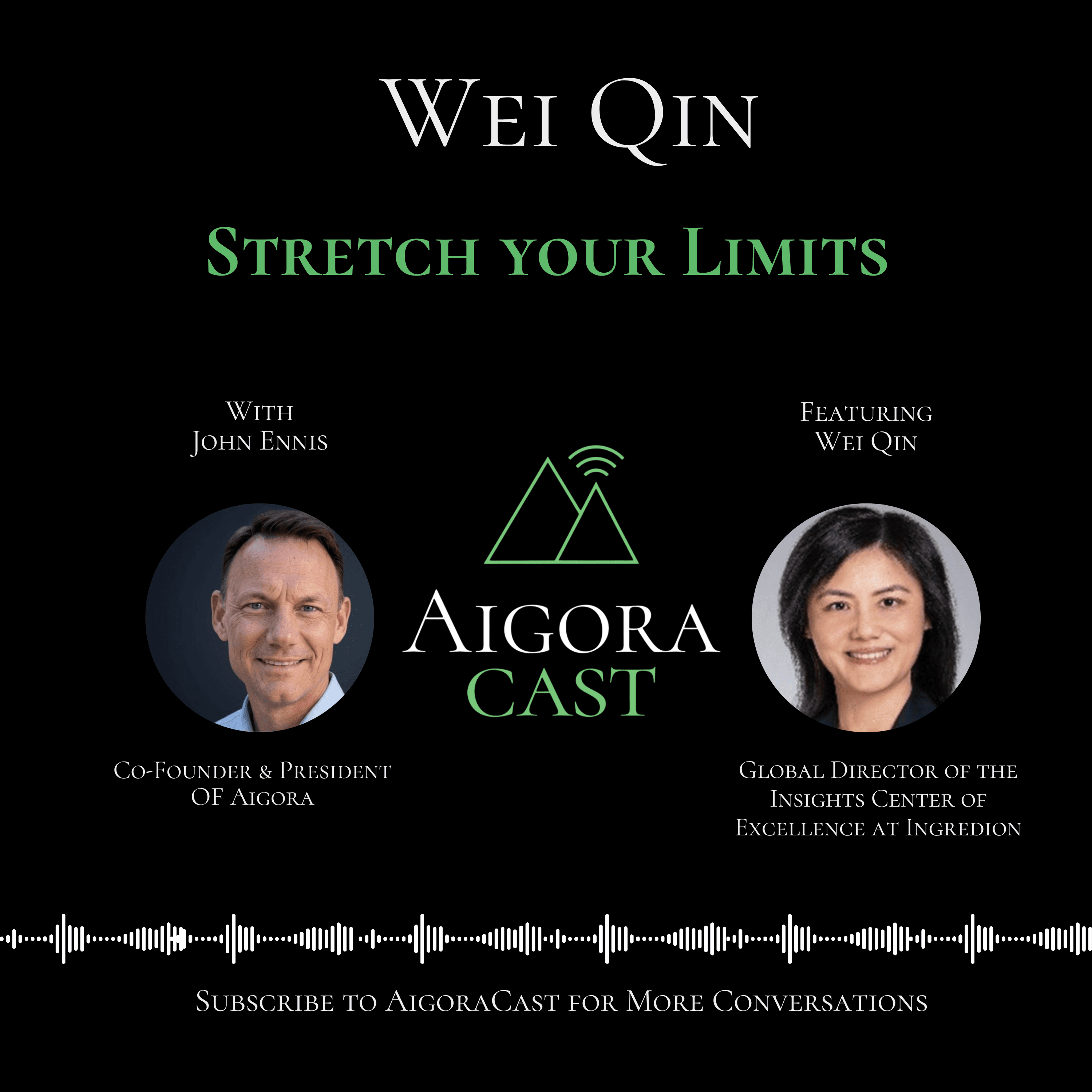
Hi, I’m Dr. John Ennis, CEO at Aigora. In this episode, I caught up with my longtime friend, Dr. Wei Qin, Global Director of the Insights Center of Excellence at Ingredion.
I particularly enjoyed her story about a flavorist using AI to find a molecule they hadn't considered. It is a great example of her view of AI as a "stretcher" for human limits. I hope you enjoy this conversation as much as I did, and remember to subscribe to AigoraCast to hear more conversations like this one in the future!
Dr. Wei Qin is the Global Director of the Insights Center of Excellence at Ingredion, where she leads the integration of consumer data into global business strategy, innovation, and go-to-market efforts. With a career spanning leadership roles at top Flavor & Fragrance houses and CPG giants like P&G, Altria, and Kellogg's, Wei is a recognized expert in decoding the "why" behind consumer behavior.
For over 15 years, Wei has served on the FEMA (Flavor and Extract Manufacturers Association) Sensory Committee, where she has been instrumental in shaping flavor modulation standards and measurement methodologies. A prolific researcher, she has published numerous peer-reviewed articles on consumer attitudes toward emerging food technologies and was an early pioneer in leveraging social media insights for product innovation. Her strategic work has directly led to the launch of two game-changing product categories now valued in the hundreds of millions. Most recently, she authored the book Gen X Asian Americans: From Learning to Thriving.
Remember to subscribe and leave a positive review if you like what you hear!
John: Hi everyone, welcome back to another episode of AigoraCast. Today I’m very happy to be joined by my long-time friend, Wei Qin. Dr. Wei Qin is the Global Director of the Insight Center of Excellence at Ingredion, where she leads the integration of consumer data into global business strategy, innovation, and go-to-market efforts. With a career spanning leadership roles at top flavor and fragrance houses and CPG giants like P&G, Altria, and Kellogg’s, Wei is a recognized expert in decoding the "why" behind consumer behavior.
For over 15 years, Wei has served on the Flavor and Extract Manufacturers Association (FEMA) Sensory Committee, where she has been instrumental in shaping flavor modulation standards and measurement methodology. A prolific researcher, she has published numerous peer-reviewed articles on consumer attitudes towards emerging food technologies and was an early pioneer in leveraging social media insights for product innovation. Her strategic work has led directly to the launch of two game-changing product categories now valued in the hundreds of millions. More recently, she authored the book Gen X Asian Americans: From Learning to Thriving. So Wei, welcome to the show.
Wei: Thank you, John. Glad to be here.
John: Yeah, it’s great to have you on here. Maybe to get everyone up to speed, could you take us through your journey and how you got to where you are now in sensory?
Wei: It’s a surprising journey to myself. I started as a biochemist; my bachelor’s degree was in biochemistry. My whole dream was about coming abroad to study advanced degrees in the U.S. But I didn't get my full scholarship after graduation, and I had to find some work during my gap year. I stumbled into Procter & Gamble as a product developer, and that completely changed my journey. That’s where I got exposure to consumer and sensory research. I found that so much more interesting than staying in the lab running test tubes. After two years, I came here to continue my graduate study but changed my subject to consumer research.
John: So you were at Procter & Gamble in China, is that correct?
Wei: Yes, I was.
John: Very interesting. It’s always interesting how everyone’s journey into sensory seems to be different, usually multidisciplinary with lots of twists and turns. So you did your undergrad in biochemistry, then your PhD was in food science. What was your undergraduate research on?
Wei: My undergrad was biochemistry.
John: And then you came to the U.S. and went to Penn State. What happened after that?
Wei: Penn State was a very interesting journey. It completely changed my view about how to approach research. My focus at the time was more on the consumer side, perception towards new technologies. At the time, what was popular was genetically engineered food, irradiation, and nanotechnology. I did a little bit of research on those three topics, but my thesis was on consumer perceptions towards genetically engineered salmon.
John: Oh, wow.
Wei: Building structural equation models on consumer drivers of food choices. After I graduated, I wanted to do an internship. My professor told me, "If you want to work in the food industry, you must understand sensory." So I took a one-year internship at Kellogg’s in the sensory department.
John: And from there, was IFF the next stop?
Wei: The next stop was Philip Morris, or Altria. I think that was my career-defining experience. At the time, it was before tobacco regulation came in. Even though it was quite strict in terms of advertising, the warning label wasn't on the pack yet, and tobacco companies were still allowed to innovate. The tobacco market had been declining, and they wanted to enter new categories. That was a very rare opportunity for a consumer researcher to look into something the company didn't know. I spent a lot of time on smokeless tobacco. That gave me the learning of the power of qualitative research and also how to better utilize experimental designs. Philip Morris/Altria had a lot of great scientists and an endless research budget, better than any company I’ve ever seen.
John: I bet. Back in the '80s, it was basically an infinite research budget.
Wei: Exactly. You could do whatever you wanted. You developed models and tried to create a good product, but you just couldn't beat the market leader. Eventually, Altria bought a tobacco company, US Smokeless. We had an exchange with the scientists there; we showed our models and the rigor of our science. They told us, "Everything was correct, but you have to understand that sometimes bacteria likes to be stressed."
John: (Laughs)
Wei: That produced the best products. That completely changed my view about experimental design and how we push the limit.
John: So within the framework of the experiment, there was an important variable that wasn't being accounted for?
Wei: Yes. You have the optimum parameters defined, but you don't understand that when you push over the limit, that’s where the best results will be produced. Connecting this to AI, this is one of my concerns about AI models.
John: I was actually just thinking those same thoughts. First off, there's a lot of talk about whether AI is going to take all the jobs. I work all day long with AI agents, and I really don't see it that way. AI can automate routine activities, but you need a human to figure out what’s important and what matters. Part of that is knowing what’s important to measure in an experiment. AI works great "inside the box," but everything it does is interpolation. Extrapolation, going outside the training set, is a challenge. It can come up with new combinations inside the box, but a big new idea or great art is likely going to be outside the box and hard for AI to accommodate.
Wei: Fully agree. But I do think AI can stretch our limits as well. I have a fairly recent example in the product development space. 50 years of research data was put into an AI model. No scientist has that long of a career. AI was able to pick up something that’s not available today. AI designed a product and made a recommendation optimized for consumer liking. It wasn't great when you tasted it, but when we presented the AI model to a flavorist, they realized, "Oh my gosh, I never thought about this molecule." Even though we didn't have that exact one, we had a similar replacement. We tried it, and that revised AI solution became the most liked product in the study. I was really impressed by that interaction between AI and humans.
John: Exactly. That’s how I see it. It’s a back-and-forth constantly with the AI. That interaction can produce great things. Speaking of AI, we ended up doing this podcast because you have your new book out and were looking into translation. AI is very good at taking a message, like the abstracts I’m proposing for EuroSense today, and presenting them in a way a committee would like. But your experience with machine translation was a bit different?
Wei: Yes. I did some trials with AI tools at the end of last year. My book was published in September. My first version was Google Translate, and it didn't work out very well. Then you suggested I buy the purchased models, so I had Gemini, DeepSeek, and Claude. I tried all of them. I have to say, I'm quite impressed. Each model is slightly different; Claude is more artistic or literary, while Gemini is a bit more scientific and logical.
John: I agree with all that.
Wei: But none of them were very close to what I wanted. I’ll share about DeepSeek, the Chinese one. I put a lot of hope into it, but it just read like Chinese propaganda.
John: (Laughs) I wonder how that happened.
Wei: I might be putting myself in trouble if the Chinese government is listening!
John: They have enough to worry about, I think they’ll be fine.
Wei: Regardless, that was the comparison. I tried to see if I could start with Gemini and then give it to another model to revise, but that wasn't a good approach. They all have pros and cons. It still needs a lot of human manipulation. The time I consumed was tremendous; I felt like I was writing another book. So, I decided to hire a translator.
John: That makes sense. You have to watch out for "regression to the mean." When you average them together, you just get something bland and flat. I heard you specifically looked for a translator who didn't use AI?
Wei: Yes. I found a few options, and because I’m in a book-writing club, I got some referrals. A lot of people tend to use AI; you can tell they aren't professional writers and charge a lower price. This particular translator was recommended by a friend and is well-known for her rigor and spending time on details. I went with her at a higher cost, but I’m very happy with the output.
John: I suspect that if that translator were to get used to AI, it could help them, but you’re always going to need that human touch for the final product. That’s what we’re teaching in our course right now; it has to be back-and-forth. I describe it to students as being like a dragon tamer. The dragon is powerful but can create trouble; you have to harness it. What other benefits are you seeing in the industry?
Wei: Before we move away from translation, in a business setting, I think AI translation is fantastic. I just had some customers visiting in China, and AI is sufficient to translate business. You only need to do minor revisions.
John: Right, because it’s not the "artistry" of your book. We have a feature in Google recently for real-time translation. We were on a call where Vanessa could hear us all in Portuguese while we spoke English. It’s a little delayed and weird, but she’s sitting there and we are all speaking Portuguese to her. What else are you seeing?
Wei: You mentioned literature reviews. I totally agree that’s a fantastic area. In the past, we had to spend so much time on that, but now you can ask AI to screen documents for you. The biggest change in the field is probably qualitative data to quantitative data.
John: Yes, and the other way too! What are you seeing there?
Wei: In the past, we threw away a lot of open-ended questions in surveys because people didn't have time to read them. Now with AI, we can ask more open-ended questions. I know people in the field are challenging whether we should always ask open-ended questions to replace numbers.
John: That’s a hot topic. One of the abstracts I’m putting out for EuroSense is on exactly what you’re talking about. It’s research with Thierry Worch and Benjamin Mathieu. Benjamin collected data in 2022 on ham research. Before people evaluated the hams, they were asked to describe their "ideal ham." Then they evaluated actual hams and described them in words. We also collected liking and purchase intent. We took that data and had an LLM rate, "Here is an ideal description and an actual description; how similar are these on a scale?" We found the LLM ratings were more highly correlated to liking than the human ratings. It’s faster and better.
Wei: I totally agree. Liking scores are not perfect; sometimes you get a high liking score, but when you launch the product, people don't like it. You’re missing something.
John: Liking is an impoverished metric. I think the field way overvalues it. What you just described is interesting. What if we go the other way? Figure out what part of those open-ends is connected to liking, take that out, and see what’s left? That might tell you what’s missing.
Wei: I can't wait to see the results!
John: I’m going to do that! That’s a new idea. Thank you, Wei. So, what do you see next?
Wei: It’s a fantastic experience for any researcher right now. We’ve gone from no computers to computer-aided surveys, and now AI. Who will be the winner is defined by whether you have good data sets. If a company never had good discipline on data collection, AI is not going to help them.
John: If the data are a mess, nothing can save that. My dad was brought in during the early days of Red Bull to try to save some research. Red Bull had been evaluated against Coca-Cola, and people gave it a 1 out of 9 on liking because the context was wrong. If you don't know what an energy drink is, you just think it's the worst soft drink ever.
Wei: I ran into a similar case study with a company that wanted to do a "Coke fighter." In a blind product test, it scored a 3 or 4 out of 7. If you looked at that data, you wouldn't launch it. But you must have the right marketer and decision-maker to understand that once it’s branded and positioned, it will work. The product launched and took 5% market share.
John: That comes down to understanding the whole consumer journey. I'm very optimistic about the future. I think AI is orthogonal to human intelligence. It supplements us.
Wei: I have a question for you: We observed about 3-5% of consumers relying on GenAI to recommend or complete their shopping list. How will that reshape retail?
John: I think companies need to be thinking heavily about Agent Engine Optimization (AEO). It’s going to be important that companies are active on Reddit and other places to be picked up by agents. If a farmer asks ChatGPT about a frost problem, my dad would want his soil conditioner product to come up. We all have to be thinking about that. Eventually, you’ll have personal agents whose job it is to stock your pantry. You need to make sure that when agents are looking around, they decide your product is the best match for their human.
Wei: Someone in the middle is not in a good place.
John: Wei, we are out of time. Any last advice for a young scientist?
Wei: Keep trying. I have a Gen Z daughter; she’s using AI every day, and it feels like ChatGPT is her best friend. Keep trying, keep using, and you will find good use for it.
John: I agree 100%. My LinkedIn header is the Nietzsche quote, "Only the doer learneth." You have to be out there doing it. How can people find you, Wei?
Wei: LinkedIn would be the best. Send me a message there.
John: Pleasure as always. Thank you for being on the show.
Wei: Thank you, glad to be here.
Disclaimer: The views and opinions expressed by Wei Qin in this episode are her own and do not necessarily reflect the official policy or position of Ingredion or Wei’s former employers.
Aigora is a contributor to the Aigora blog, sharing insights on AI-powered sensory science and product development.
Hank Margolis joins AigoraCast to discuss building Zevia, improving formulations, earning trust, and staying open to changes in the beverage market.
Welcome to AigoraCast. Conversations with industry experts on how new technologies are impacting sensory and consumer science.
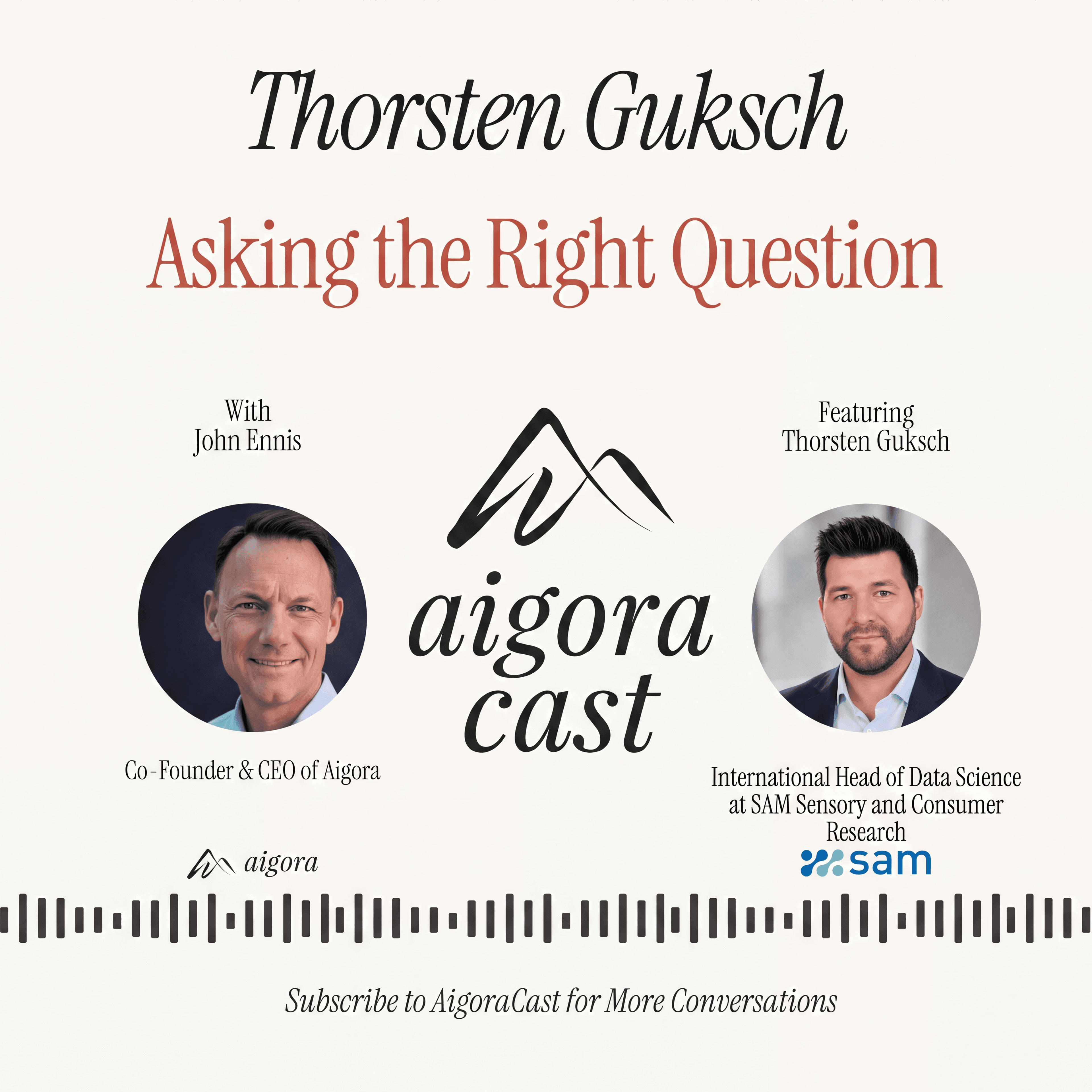
Hi, I'm Dr. John Ennis, CEO at Aigora. In this episode, I enjoyed speaking with Thorsten Guksch from SAM Sensory and Consumer Research. We talked about what happens when sensory science meets modern data science, focusing on how machine learning turns open-ended consumer language into structured sensory information, and why multisensory measurement captures product experience that a single-sense test misses. I hope you enjoy this conversation as much as I did, and remember to subscribe to AigoraCast to hear more conversations like this one in the future!
Tell us what your team is working on through our contact form. We'll review your request and reply within one business day.