Hybrid Knowledge Management
How a global health brand built a “Corporate Brain” that reduced lit reviews from days to seconds
The Situation
A leading global consumer health brand with a sophisticated database still struggled to bridge the gap between “what happened” (numerical scores) and “why it happened” (qualitative context). Years of expert tasting notes and PDF reports remained siloed from the numerical data, requiring researchers to manually hunt for context during lit reviews—a process that often took days.
How Does Hybrid Search Solve the “Why” in Sensory Science?
Quantitative data, such as consumer liking scores or analytical measurements, tells researchers what happened. However, the qualitative context required to understand why it happened is often buried in thousands of historical PDF reports and external journals. Hybrid Knowledge Management eliminates this disconnect, allowing researchers to correlate hard numbers with narrative insights in a single, unified inquiry.
Methodology: The Theus Platform
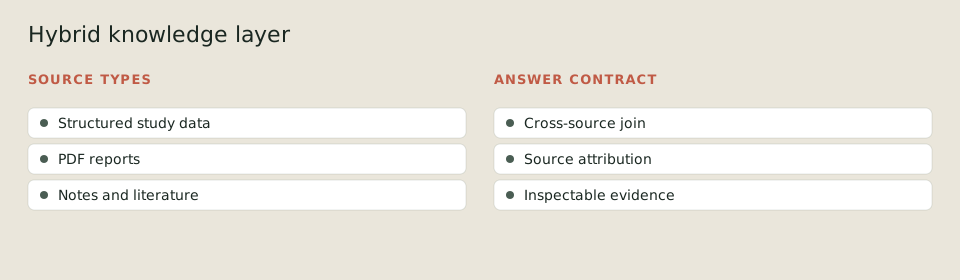
The integration utilized Aigora's Theus platform to correlate structured data with unstructured knowledge, prioritizing provenance and accuracy over simple text generation:
The Multi-Modality Pipeline
The infrastructure maintains distinct but connected pipelines for different data formats:
- ●Structured Stream: Real-time access to SQL databases containing sensory scores and instrumental variables.
- ●Unstructured Stream: An ingestion pipeline that indexes internal historical reports, expert tasting notes, and relevant scientific PDFs.
- ●External Benchmarking: Integration of curated external scientific literature to provide market and academic context.
Contextual Retrieval-Augmented Generation (RAG)
Unlike generic AI tools, a scientific “Corporate Brain” must be high-precision. The system utilizes RAG to ensure that every answer is generated only from the provided knowledge base, preventing “hallucinations” and ensuring that every insight is verifiable.
Strict Source Attribution & Provenance
A core requirement for enterprise research is data governance. The platform is engineered to explicitly cite its sources, visually distinguishing between:
- ●Internal Proprietary Data: Insights derived from the organization's own historical studies.
- ●External Scientific Literature: Context provided by academic journals and third-party research.
Strategic Impact of Hybrid Systems
| Standard Knowledge Retrieval | The Corporate Brain (Hybrid) |
|---|---|
| Siloed search: User must search databases and folders separately. | Unified search: Correlates SQL data and PDF text in one response. |
| Results are limited to raw data or keyword matches. | Results are synthesized into an actionable narrative summary. |
| High risk of losing historical “qualitative” context. | Preserves and resurfaces historical expertise for every query. |
| No distinction between internal and external data sources. | Strict citation ensures clear data provenance and governance. |
Impact: Scientific Acceleration
Value for Research & Development
The transition to a Hybrid Knowledge environment provided three critical advantages for R&D leadership:
Technical Execution
The THEUS platform is built for high-security, regulated environments:
Agentic Reasoning: Powered by advanced models with custom reasoning loops for data validation and multi-step query resolution.
Security & Deployment: Hosted on secure enterprise infrastructure (Azure/AWS) with strict user-level access controls and SOC 2 Type II compliance.
Modern Stack: A sophisticated frontend built with Next.js and shadcn/ui, prioritizing clarity, citation visibility, and a premium user experience.
“By integrating our structured data with decades of internal reports, we've created a corporate brain that makes our collective expertise instantly searchable.”
— Global Director of Brand Experience, Global Health Brand
Ready to Transition Your Knowledge Management to Living Infrastructure?
See how Aigora's THEUS platform harmonizes structured data with qualitative knowledge to create a permanent institutional memory for your organization.