Skip to content

Predictive Modeling & Virtual Prototyping

How a Fortune-100 personal care manufacturer simulated consumer success before entering the lab

The Situation

A Fortune-100 personal care manufacturer was struggling with the high costs and extended timelines associated with physical consumer studies for its men's grooming category. With limited historical data and a need to optimize several new prototypes, the company sought a way to simulate consumer success in-silico. The goal was to identify sensory drivers of liking and predict performance before moving to physical production.

How Does Predictive Modeling Reduce Development Timelines?

In traditional R&D cycles, the path from prototype to market is linear and iterative, often requiring multiple rounds of physical sampling and consumer validation. Predictive modeling transforms this into a parallel process. By identifying the specific sensory drivers of “Overall Liking,” researchers can adjust product variables such as intensity, texture, or aromatic notes within a digital environment to identify the optimal configuration for success.

Methodology: The “Playable Model”

Aigora's approach to predictive modeling is designed to be interactive and transparent, moving away from “black box” algorithms toward tools that empower human intuition:

1

Multi-Source Data Alignment

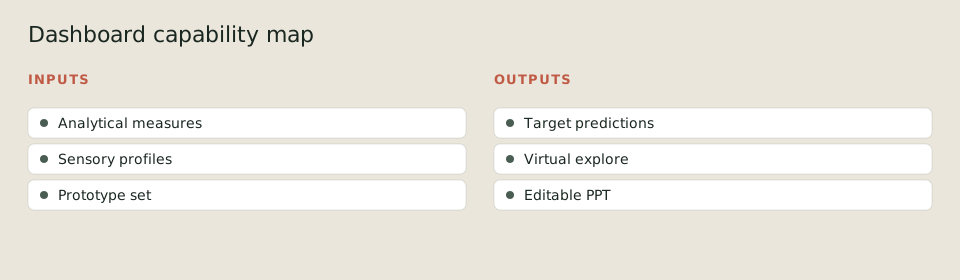
The process begins by aligning disparate datasets:

  • Sensory Descriptive Data: Standardized attributes identified by expert panels.
  • Analytical Measurements: High-precision lab variables (e.g., pH levels, viscosity, chemical concentrations).
  • Consumer Targets: Historical liking scores and demographic feedback.
2

Exploratory Landscape Analysis

Before a model is trained, a comprehensive Exploratory Data Analysis (EDA) is conducted to understand the full sensory landscape. This step quantifies the contribution of each variable, identifying which analytical measurements correlate most strongly with sensory perception and consumer preference.

3

Interactive Simulation Dashboards

The final model is deployed within a “Playable” dashboard. This interface allows developers to:

  • Adjust Input Sliders: Manually manipulate key variables (e.g., increasing “Intensity” or adjusting “Scent Notes”).
  • Instant Prediction: See an immediate update to the predicted consumer liking score.
  • Compare to Benchmarks: Visualize how a virtual prototype sits within the competitive landscape of existing products.

Strategic Impact on Product Development

Traditional PrototypingVirtual Prototyping (Predictive)
Requires physical production of every iteration.Simulates thousands of variations digitally.
High cost per consumer test iteration.High upfront value that compounds with every simulation.
Insights limited to the specific products tested.Uncovers the underlying drivers of liking across the category.
Reactive: “Did they like this prototype?”Proactive: “What profile will maximize success?”

Impact: Strategic Product Optimization

Timeline Reduction: Shortened development timelines by filtering out low-probability prototypes digitally, reducing the total number of required physical tests.
Virtual Experiments: Enabled developers to perform thousands of in-silico experiments to find the “sensory sweet spot” for new product launches.
Actionable Drivers: Identified previously undiscovered sensory drivers that correlate with consumer liking, creating a lasting strategic asset for the category.

Quantifying the Value of “In Silico” Research

The integration of predictive modeling into the sensory workflow yields three primary organizational benefits:

Reduced Test Fatigue: Minimizes the number of consumer studies required by filtering out low-probability prototypes early in the cycle.
Strategic Resource Allocation: Redirects research budgets from routine testing toward high-value innovation and foundational learning.
Intellectual Compounding: Each new study retrains and refines the model, ensuring the organization's “predictive accuracy” increases over time.

Technical Infrastructure

Aigora implements these systems using a modern, maintainable technology stack that ensures the model remains a living asset:

Modeling Core: Advanced machine learning algorithms (Random Forest, Gradient Boosting, or custom regression models) developed in Python or R.

Interactive Interface: Custom-built dashboards (Next.js or Dash) designed for intuitive interaction by non-data scientists.

Retraining Capability: Automated pipelines that allow teams to ingest new data points, ensuring the model evolves alongside shifting consumer preferences.

“This platform has turned our sensory data into a playable asset, allowing us to predict consumer success before we ever enter the lab.”

— Global Sensory Science Lead, Personal Care Division

Ready to Transition Your Product Development to Living Infrastructure?

See how Aigora's predictive modeling tools can simulate consumer responses and optimize product development before a single prototype is produced.