AI Expertise for Consumer Insights

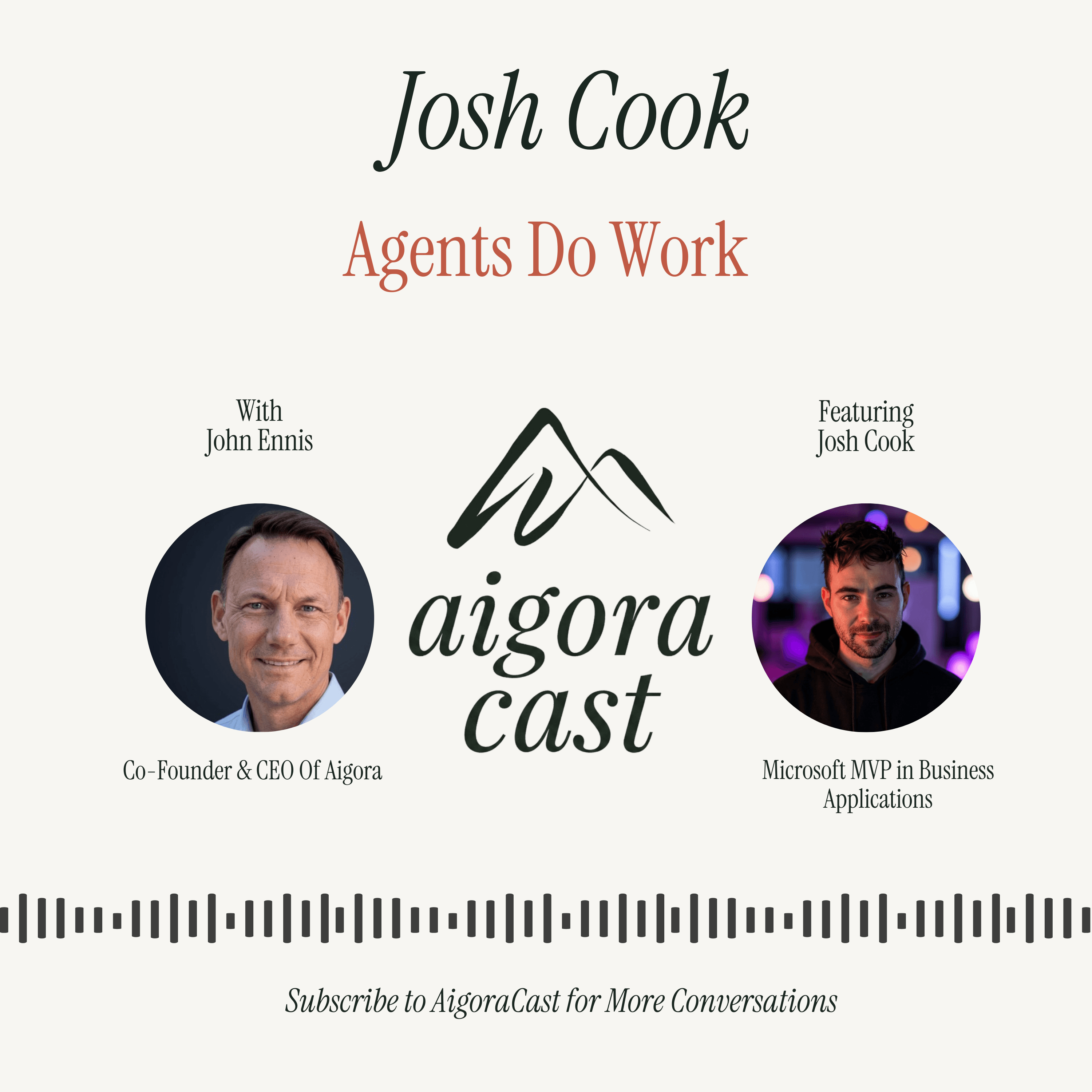
Welcome to AigoraCast. Conversations with industry experts on how new technologies are impacting sensory and consumer science.
AigoraCast Episode, Agents Do Work , a conversation with Josh Cook is now live!
LinkedIn: Josh Cook
Content Hub: FlowAltDelete
Expertise Areas: * Microsoft 365 Copilot & Copilot Studio
Power Platform Architecture (Power Apps, Automate, Pages)
Low-Code Governance and Scaling
Enterprise AI Implementation
Visit your favorite platform and remember to subscribe:
Apple Podcasts
Spotify
Please leave a positive review if you like what you hear!
Transcript:
Dr. John Ennis: Hi, I'm Dr. John Ennis, CEO at Aigora. In this episode, I had the pleasure of speaking with Josh Cook of Flow, Alt, Delete, a Microsoft MVP and true master of M365 CoPilot. Many of our clients and students use CoPilot as their daily driver, so it's great to have an expert on CoPilot on the show to share his excitement about the powerful new way of working it enables. I hope you enjoy this conversation as much as I did. And remember to subscribe to AigoraCast to hear more conversations like this one in the future.
John: Welcome back everyone to another episode of AigoraCast. Today I'm very happy to have my friend Josh Cook on the show. Josh Cook is a Microsoft MVP in Business Applications and a prominent expert in the Microsoft AI and Power Platform ecosystem. He specializes in designing enterprise-grade solutions that bridge the gap between people, data, and intelligent workflows using Power Apps, Power Automate, Dataverse, and Microsoft 365 CoPilot.
As a community leader, Josh directs the Calgary Biz Apps Community and hosts workshops and hackathons designed to empower the next generation of builders. Under his content brand, Flow, Alt, Delete, Josh focuses on making complex AI and low-code technologies approachable and actionable. He's widely recognized for his ability to help organizations move beyond the initial hype to design and govern scalable systems that connect people and intelligent agents in the next era of work. So Josh, welcome to the show.
Josh Cook: Thanks John. Super glad to be here and love to... can't wait for our chat today.
John: Yeah, well I know that, you know, in my corner of the world, in sensory consumer science, almost everybody uses CoPilot. And I'm, you know, I'm teaching this course, this AI course for sensory consumer scientists, and as a result I had to use CoPilot, you know, not normally my first choice, but I was having to use it and teach it. And I was one night on X complaining about CoPilot, and you were one of the few people to say, you know, actually Microsoft CoPilot is awesome. And we connected through DMs, and you sent me a bunch of resources and they were really helpful. And my students benefited. So I thought it would be only appropriate to have you on the show and talk about your experiences and, you know, tips, tricks, advice, life thoughts on AI and CoPilot.
Josh: Yeah, it's kind of funny, John, that you say that because I actually push back on a lot of people on X and LinkedIn actually. And sometimes I get a lot of hate back. Sometimes I actually, you know, I meet a new friend like you! And other times, you know, people are just unaware of actually what's going on. I feel like Microsoft, they get a lot of hate all the time. I used to hate on Microsoft, right? Everyone just hates on Microsoft just for fun.
But in this case, yeah, CoPilot in my opinion has come a long way. It's like if you asked me the same question like "Oh, is CoPilot great?" about a year ago, I would probably 100% agree with you, be like "CoPilot is bad, right?" But Microsoft, I feel like they've pulled up their, pulled up their pants and they made it a little bit... they understood really what CoPilot, what the difference is between a CoPilot and like if you were to use ChatGPT or Gemini or even Claude. So they kind of they kind of integrated it into into how you work and that's really where CoPilot shines. We can get into it, but it's mainly the work IQ or the work intelligence that makes CoPilot CoPilot.
John: Oh, very interesting. Okay, well yes I definitely want to get into that in a minute. But let's start with just stepping back and maybe you can tell us about your journey. How did you... so right now you know you have your... you do consulting and you work with cities which is interesting, but maybe you can tell us just about your journey to how you got to where you are now.
Josh: Yeah, so I mean I've always been a big tech guy, even when I was a kid, as a teenager, I was gaming a lot, always into technology, self-made hacker, maybe let's... maybe let's not get into that. But I was always big into computers. And my wife, I got married really young, like 22, but my wife, before we had kids, she was telling me like, "You know what? You have this really bad warehouse job, you should probably go back to school and just get a degree so you can actually get a tech job because you're so good at technology and hacking." And to be honest, my very first thought was, "Oh, I'm going to go back to college, get a degree so I can become a certified ethical hacker." That was actually my first goal. I wanted to be an ethical hacker where I go in, do some pen testing, penetration testing, and you know, find bugs for organizations. That was really my goal.
When I when I signed up, kind of a funny story, I got a call... so first my wife, she randomly found out she got pregnant. So she was pregnant with our first kid, and then I got a call from the school saying, "Oh, you're off the waitlist, you can come in, you can basically start next month." And I'm like, "Oh wow, what do I do, right? Do I not do it because my wife's pregnant? Do I go to school and just take the L and, you know, we kind of work things out as as, you know, the finances and everything is pretty pretty pretty big when, you know, no one's working now, right?" Because of a child now, right? And going back to school. But anyway, decided to go back.
Now, at the time, it was SAIT, which is our post-secondary college type thing in Calgary, but the time, the certified ethical hacker course was brand new and it wasn't actually open yet. It was going to be open the following year, so I'm like, "Ah, I'll just take Computer Systems just so that I have a degree." Went in there, had a great time developing, and so, Computer Systems, a little bit of everything. You get a little of networking, a little of software development, a little bit of hardware, so you get a little bit of everything in Computer Systems.
And towards the end of it, our very last project, you have to come up with a very niche and big project as your final, final project, and at the time, this was in 2018, I believe, Bitcoin, blockchain, very new, right? It was kind of getting mainstream but it was very new. And I decided with my team, I'm like, "Hey, we gotta build a blockchain for our school, for the final project." So we actually built a blockchain that could store your credentials, like your transcript, and it had all your grades and everything, and then you can actually share it with employers without actually showing them your grades. So you can basically prove that you've taken the course, that you've passed, and that you have a transcript that meets their criteria, without actually sharing the credentials.
So that was actually a very niche project, and actually they kind of took a little bit of it, a bit of it, and actually integrated it into actually how they distribute transcripts now. So actually, my transcript from that school, yeah, my transcript from that school is actually half on a blockchain. Maybe nowadays I'm thinking of it, eh, blockchain's not that, you know, it's not that hyped up now, but I mean at the time it was pretty cool. And on that project I got like 98% and our whole team like, it was very, very... it was one of the best projects actually the school has seen, they told us.
But anyway, then I was like, "Okay, now I need a job, right?" And SAIT, I actually love... one thing that I love about them is that they have a job portal where companies actually go and post jobs on there. And on there, I'm obviously putting up like, "Hey, I've built a blockchain," you know, "I'm brand new, nobody's really done this stuff before." And the person... my very first tech job was at Inter Pipeline. It's a pipeline company in Calgary, but what the role was for was for an integration developer. So again, never really had experience with Azure or Microsoft per se, but I found out after, the reason why this person hired me is because he seen on my resume that, "Hey, he built a blockchain. I can teach him to do anything, basically."
John: Oh, there you go.
Josh: And at the time, it was Azure integration was not very new, but it was kind of complex, right? It's not something you can just grab and easily do it confidentially. So he was he was taking a gamble on me about, "Hey, he can build a blockchain, he can grasp grasp technology fairly quickly and and and learn things easily," so I kind of got my foot in the door there.
Kind of funny, the guy who hired me was a Microsoft MVP at the time, and he used to work for Microsoft, and he was actually part of the team at Microsoft that built Microsoft Flow, which turned out to be Power Automate. So he actually helped build that. So he was a good mentor to me actually, because as I was working there, I was finding out like, "Hey, how does this guy do this, right? He's leading my team, he's so smart, like everyone looked up to him, right?" And then also he did a lot of blogging, a lot of speaking. He was known in the community as well, and I didn't even know what an MVP was, Microsoft MVP, and I kind of did some digging myself, "What is this MVP? How do you become one, like?" It just intrigued me.
And I guess for people that don't really know, a Microsoft MVP, the only way to get it is to get nominated by a Microsoft employee or by a previous or by a current MVP. And just getting nominated doesn't get you into the program. They just nominate you and then you have to basically show Microsoft, "Hey, this is what I've done in the last year." Community work, right? Like, "Oh, I've spoken at these events, I've went and I blogged, maybe I do some vlogging," but "This is what I've done in the last year." And then Microsoft, they have three different teams and they kind of say, "Ah, yes. Oh no, oh yes." And if you get two yeses, then you're part of the program for that year. If you get two nos, then you obviously get declined. But it's a yearly thing. So like every year, and actually I have to submit my submissions here by the end of this week, or by the end of next week, to find out if I'm an MVP again for the sixth year. So, but it's been a pretty big journey.
So that's really where I kind of got introduced to the Microsoft stack, really, like within Azure and then... because it's kind of funny, right? It was in Azure, which is like Logic Apps, Azure Functions, Service Bus, all this type of stuff in Azure. And then at the time, I was also just getting my hands deep into like Power Automate, which is basically the little brother of Logic Apps. Um, so I kind of was digging into that, and I just I kind of just felt more at home with the low-code technology they call it, right, Power Platform.
And then I decided, "You know what? I'm going to... I want to become an MVP." So I really went head deep into the community. Now, at the time, I wasn't really good with Power Automate or anything with the Power Platform because I was very new. But I have ADHD, and the best way that I learn is by doing, right? I can talk and read all the time, doesn't matter. The way I learn is actually by doing it. And what I found was, if I go to the community forums, there is tons of people that were having issues or having questions, and I'd have the same questions most of the time. And what I would do is I would I would go and I would read the questions, I'm like, "Oh yeah, I'm going to... how do you do that? How could I, you know, run a parallel flow and and and update SharePoint and SQL at the same time, and do all these different things?" So then I kind of was replicating what they were doing and then I I found some in most times, I figured out the answer or the solution to that to that problem that people were having. And instead of just finding that solution and then going out my day, I would actually spend my, you know, a little bit of time to actually post in that community my my answer. "Hey, this is how I figured it out, you know, this is what you should do."
And it got a lot of traction and a lot of people from Microsoft were actually noticing that I was very head deep on the community. I was answering like maybe like 200 solutions or answers a month, which is a lot because... and the bad thing about the community is that most people they'll go there, ask a question, even if you answer it, it might it might sit there as unanswered forever because they won't go back and they won't mark it as a solution. So sometimes your work that you're doing, it might just get thrown away, who knows? But that's not the mindset that I wanted to have. I kind of just wanted to continue on my community stuff because I was learning so much doing that.
And doing that, I obviously caught the attention of Microsoft and I became an MVP the following year, so I actually my journey to become an MVP was very, very quick because I was so... I was so narrow focused on it, right? Like, that's just an ADHD trait. I hyperfocused on it so heavily that I got the attention of Microsoft. And that's really... there's a few little tips and tricks that I tell my fellow peers about, "Hey, how can you become an MVP?" because there's no real steps to do it, but it's it's something that you have to be mindful and and there's certain tips that you can do. But also, why do you want to become an MVP? There's a lot of different perks to it. I get to chat with the product team, I get to be part of private previews, I get special licensing, and I get to, you know, talk about a bunch of different things.
John: And you get to know that the CoPilot is getting better faster than anyone else, of course.
Josh: Yeah, pretty much.
John: So that kind of brings us back to the original discussion, yeah. First off, there's a ton of stuff in what you said that I think we should touch, just for general education. One thing is the universe rewards focus, and the fact that you were focused on this goal, I think, was extremely important. And I think that people do need to take a minute and think about what do they want to do with their life. It's probably more important right now to think about that than any other time in history because it's going so fast.
But the other thing is you were talking about the low-code solution... oh, the fact that you're a generalist. I think you were talking about going into Computer Systems, that you had learned a lot of things. I think in the age of AI, the most important trait is somebody who is open-minded and able to learn, just willing to learn whatever, because AI is there with you, and you can learn by doing. That's the third thing you said that really stood out to me, is that with AI, you need to learn while doing, that you're, you know, don't, you know, I had this with I have this with my students that we've done in the second cohort now, a lot of people think that AI is something you're going to study, and you learn all these prompting techniques, and you like study, study, study, the way you might learn statistics or something, and then you're going to be do AI, but that's not the way to learn.
So maybe talk about your experience now with AI. So how did you get into using AI and what's been your process for, you know, improving your proficiency as an AI user?
Josh: Yeah, great question because actually AI is fairly new actually, if you think about it, which is crazy to think about. But yeah, so right before AI came into a big thing, I was really deep into the Power Automate. I was known as the Power Automate guy, I would automate a lot of different things. So almost AI, right? It's kind of on the verge of it.
But I remember using the very first AI tool when I heard about it, it was called Jarvis.ai. They had to change the name because of obviously third-party legal concerns. But when I used it, it was complete trash, cost $200 a month, but it was bad. It was definitely before GPT-3 days. But anyway, when when that happened and then OpenAI came out and they started like showcasing, "Hey, here's GPT-3" and everything like that, and Microsoft kind of jumped right on board with it, that's kind of where I was... I was jumping on board as well.
But to be honest, right at the very beginning, like I was one of the first persons to get access to CoPilot as well, and at the very beginning, it was good, it was it was it was alright, because it was the first thing, right? I didn't know anything else. But as time went on, I was like, "CoPilot is kind of, you know, it's not really doing what I want it to do, like I'm asking these simple things where I feel like it should do it, why isn't it doing it?" and yeah, it's been a journey since then. A lot of the times, I'll be completely honest, a lot of the times I was copying stuff out, pasting it into ChatGPT and running with that.
John: Yeah.
Josh: Fast forward to today though...
John: Yeah, yeah, so... but we're actually getting a little short on time so I've got to I've got to make sure I get to the key questions for the audience here. So, all right, so as far as CoPilot goes, this is I think a really interesting point that you've made. You seem to think of CoPilot as a categorically different tool from, say, ChatGPT or, you know, the Claude web interface. What is it that you think makes gives CoPilot kind of unique advantage, and what is it that you talk about the work IQ system? You know, what's the right way to think about CoPilot?
Josh: Yeah, so like to be honest, I'll kind of go over the other aspect here, is that a lot of people think CoPilot is a model, and it's not, right? It uses and everyone kind of thinks, "Hey, it just uses ChatGPT models." That used to be true, but it's not now. CoPilot is fully multimodal. It uses Claude models and GPT models.
And the thing is, what makes CoPilot CoPilot is, if you're deep into the Microsoft ecosystem already, right? I use Outlook, I use Teams, I use Word, I use Excel, I use PowerPoint, I use SharePoint, all this type of stuff that's in Microsoft. CoPilot plugs directly into that. And that's called Work IQ. It knows how I work, it knows who my manager is, it knows all the stuff that I do, all the meetings I attend, all the projects I'm on, and I don't have to tell it that. It just knows that because of the context that it comes with, with the Work IQ of like me using all the tools that I use.
And that's kind of really where it kind of differentiates itself from other tools like Claude or ChatGPT, is that it has the full work context just out of the box. You could technically probably get some work context going like within Claude or within GPT, but it requires custom tooling to actually plug into the, you know, MCP servers and stuff like that, whereas CoPilot, it's just there out of the box. And as you've as you've noticed, it's hard to get away from CoPilot. It's embedded in every single app.
John: Yeah, yeah, it's true. So you think of CoPilot as a system, as this intelligent system, and it uses the models, but the but CoPilot is a system, whereas Claude is more like... okay, there's a harness there, but still it's mainly a model that has connectors that can you can connect to Gmail, you can connect to Slack, etc. But in your mind, CoPilot is a little bit more comprehensive, more holistic, that the whole system is CoPilot. It's not like that it's...
Josh: Yeah, yeah, it's like an ecosystem, right? It's like the whole work context becomes the ecosystem and how actually how the LLM kind of works across it, like it's become so smart over the over the course of that, and Microsoft enabled Work IQ in November. So it is very, very new. And if you haven't used CoPilot since like 20... like since January, I would say try it again because it's it's way better than it was.
John: Right, now one tip you gave me that helped me a lot is there's something called like the Frontier program or something like that. There's settings that people should talk to their... so what are some tips now, if someone is, you know, they're a company that says you have to you have to use CoPilot, what are some things they should do to set up their CoPilot? Things they should ask for? Steps they should take so they can maximize their use of CoPilot?
Josh: Yeah, I mean, the main thing, and I've seen people do this all the time, is that they use the CoPilot free model in the work and that is... it's not good, right? If you if you need to get if you want to get the value out of Microsoft 365 CoPilot, you have to have the premium license, which is the $30 a month one. If you have that, you're golden.
The first thing to do, and I think this is one of my tips to you, is change the model right away. The... I've always selected the model at the top right corner whenever chatting with CoPilot, selecting it to a thinking model. My favorite right now is 5.4 Think Deeper. 5.5 will be coming out here probably in a few days. But that's really how I kind of value the different models.
The Frontier program, yes, a lot of the great features like agent mode in Excel, agent mode in Word, were there first for Frontier customers. Everyone likes to think Frontier is like some secret program. Really what it is, it's just a couple of settings you have to do in the tenant, which I do have a blog on, which I'm sure you'll share at the at the notes. But um yeah, it's very couple of settings that you can enable to give yourself really your whole organization the newest and greatest tools with that, though, because, you know, because everything's kind of brand new and kind of like in a preview stage in Frontier, they do rely on feedback a lot. And me chatting with Microsoft directly, they love the thumbs up thumbs down features. If you have any issues with CoPilot, put the thumbs down, give it your feedback, and they actually do have real people, not AI, to actually look at those feedback and and implement as accordingly. So.
John: Yeah, very interesting. Okay, so if somebody's at a large organization, they're they're at a big company, they're at, you know, Procter & Gamble or whatever, and they have a CoPilot, they should contact their IT team and they should say, "Look, to maximize my productivity, I'm asking you turn on Frontier for me." And do do what they can to get access to Frontier. That would be one step.
Josh: Pretty much.
John: Yeah, because actually one of the...
Josh: Yeah, because actually one of the steps actually is um one of the things in Frontier is being able to have the multimodal, right? So by default, it's not multimodal. You only have access to GPT models. But if you want to be able to use Claude, you want to be able to use Opus, use Sonnet inside of Microsoft 365 CoPilot natively, there is a setting inside the Frontier to allow that as well.
John: Right, and then your other recommendation would be just switch to 5.4 Think Deeper and stay with that.
Josh: I pretty much change it.
John: Just don't let it... yeah. I have... I have codex extra high fast on all the time, that's I only have to rename a variable and it's codex 5.5 or it's GPT 5.5 extra high, rename a variable, okay.
Josh: Yeah, tokens, right? Got to burn them.
John: Yeah, but you know what's interesting, though, Josh, I mean I haven't gotten into this level of detail, but it is true that if you're using LLMs to do analysis, sometimes non-thinking models are better at certain tasks than thinking models. That's a very interesting result, that for scoring, that if, you know, for similarity, it's kind of there's some nuance here, but I agree with you, for work, just turn on the best model and stick with that, yeah.
Josh: Yeah. 5.5 does fix that, though. I noticed with GPT. GPT-5.5, even if you use the highest thinking model ever, um if you ask if you ask a very simple question, I notice it doesn't think as much. It knows that it's not a hard question.
John: Oh, it has adaptive thinking. Yeah, that's interesting. Okay, okay, great. All right, well then let's talk then about your about agents because that's another big area, obviously. You have CoPilot agents and you have agents all throughout the Microsoft ecosystem. What are some of the... how do you see people using agents effectively? What does effective agent use look like versus, you know, because they have this people have this thing, they are agents, and they click on agents, they don't really know what to do with it. So how should people think about agents and what are your tips for how to make the most of agents in your daily life?
Josh: Yeah, I mean, and I know it's going to sound very nuanced and probably it's like, "Oh really, like this probably gets into the dark ages of AI," but really, people like to think of agents like they how they were thinking about chatbots, right? Chatbots answer questions, agents actually do work.
Now, my my best favorite device actually, and this is kind of going off of, "Hey, you don't need to be a prompt engineer to talk to agents," I talk to my agents and my LLMs like I do with a real person, right? If I have a developer on my team and I'm like, "Hey, I need you to change the a couple of things, write some bugs in this code, I need you to fix this like right away," I would talk to an agent the same way I talk to a human, and because I'm basically giving it all the things it needs, right? I'm giving it the goal, the purpose, the expected outcome, and letting it go, right?
And if it comes back, and this is one thing that I see people do all the time, they ask an AI or an agent a question, it comes back, it gives them an answer or does something that they don't like and they're just like, "Oh, it doesn't work. Oh, but I push back all the time. I push back. You have to. And that's actually where you see the full value of agents, is that you're working together with it, not just prompting it one time and leaving, you're actually working together through the whole process or the whole task, and if it makes mistakes, tell it that it made a mistake, and it'll, you know, I know there's big there's those memes out there like, 'Oh, you chopped off the wrong arm. Oh, you're right, I did chop off the wrong arm.'"
John: Yeah.
Josh: But, um, the same thing goes of just regular small small things that you're doing, right? Like, oh, if it updated the wrong document, if it didn't add the logo, tell it to add the logo and it'll it'll happily do it.
John: Yeah, no, that that I see that exact same thing. In fact, I even wrote the article "Water the Tree" on this idea, that like, the biggest change that people have to make to work with AI properly is their mindset. And they need to think of... I actually think managers, people who have managerial experience, have the inside track here because if you're used to delegating to people, you're used to getting work back that's probably not as good as you would do if you did it yourself.
And I think that the people who have the biggest challenges with AI are the people who are very good individual workers, but they don't have managerial experience. That's really the people who have the biggest challenges, right? They turn a task over to an AI, the AI doesn't do it as well as they would have, and they say, "It doesn't work," and then they're done with it, right?
Versus a manager gives a job to an AI, comes back, it's 60% done, there's some big errors, but, you know, it's got good stuff, and they say, "All right, this is good, got to fix this, do it again." And that's what you do with a person, right? You iterate, you mill. And you have to do that. That pushback, you can't, it's not like a search engine, it came oh, you got the wrong answer, the end. No, it's a it's a tool that you have to use iteratively or you're just not going to... Well, okay, that's very good.
So, um, we're actually almost out of time, amazingly. It's we can you and I could probably talk forever. I want to talk to you about the future of work. So what let's talk about where you see work going now. Now that, I do think people are we are in takeoff. Now it's a question of how far up it's going to go, but it's definitely like we're going through some sort of phase shift right now, and the closer you are to the coalface, the more you see it, you know. Like, you and I are out there coding every day. And so you really see that it's just going parabolic. Um, it's going to trickle its way out to everybody. What do people need to be thinking about right now to make sure that they do well during this transition, as opposed to being left behind?
Josh: Yeah, I mean, that's a good question. Like, I feel like a lot of people think that AI is just going to randomly, bam, take their job. That's definitely not the case. You're going to be working with AI for at least a while before it starts doing these things where it's just like, "Oh, AI just does everything." You need to work with it. And, you know, organizations and people that are not willing to do that, because there's a lot of people that are like anti-AI or, "You know, I'll never use it, you know, it's a waste of time," if if you're one of those companies, one of those people, I I feel sorry for you because you will be left behind in a way. AI will take their job because they're not using AI. I feel like if you're not going to use AI, you will be replaced by someone who will use AI. Um, so it's not AI taking your job, it's going to be the person that's using AI is going to take your job.
John: Right, that's right. And you try to tell people that, you try to tell people that on LinkedIn, and you're trying to help them, but they take it as a threat.
Josh: Yeah, totally.
John: And I'm not trying to threaten you, I'm trying to help you here, this is just a fact that, you know, like, this is coming and and I want you to succeed, but you need to change, like...
Josh: Yes.
John: ...it those LinkedIn conversations can be pretty brutal. Yeah, okay.
Josh: Oh, yeah. Same with X.
John: X is a little bit better, but X is a little more bifurcated. You get the super hardcore anti-AI people on X. X is just more polarized. Everything's so polarized. Yeah, okay, Josh, well this has been really good. I mean, I could talk to you forever, but we do have to kind of wrap it up. Um, so let's have some parting advice. So right now, you know, we have this big transition going, what should people be doing over the next, say, six months to a year to, you know, help themselves do well during this change that we're undergoing?
Josh: Yeah, I feel like, you know, try to use AI. If you haven't already, try to use it in something, right? Automate one thing in your in your day-to-day life, whether it be personal whether it be your personal life or work life. Um, just try to do something, right? Because either you will see the value in it or you'll see where it can improve and you can kind of go with the flow there.
Because again, this is not like the the on-prem to cloud transition. This is definitely way bigger and people are really, I don't feel like people understand it. And it'll just it'll hit them in the face like down the road and they'll, you know, it'll it'll take them so much longer to catch up because I myself find it very hard to keep up with everything, and I'm only focusing on very niche scenarios, and I feel it's hard for me to keep up with my own the own stuff that I use every day. So I I couldn't imagine if I had to jump into it cold water and learn everything. It'd be it'd be hard.
John: Yeah, well, to kind of build on what you're saying there... Yes, of course, you know, if you what I liked about what you just said is "automate one thing." I think that's really good because you can use AI, but without automating anything. You can basically say, "All right, I'm going to... you're using AI to help you to write your emails," okay? You know, that might be a regular thing that you do.
But I think that the level up for people is they pay attention to what jobs they're doing throughout the day and see when you're doing the same job regularly. Like, are you regularly emailing your manager? Well, if you are, instead of just every time, you know, you open up CoPilot and you get help with an email, see if you can create a prompt that you save, or better yet, create an agent that's like "email my manager agent" and, you know, like, before the show, you and I were working on your bio, and I have a little agent I have actually just little Gemini gem, it's not really fancy, but it it knows how to take information and make a bio to introduce people on the podcast, right?
And any regular task, because I think that that that transition from a user of AI to being a creator of AI tools is a really one important one, where you can, you know, because that's something a good manager does. A good manager pays attention to their team, figures out what their team is doing and works on the processes, or the processes, since you're Canadian I'll say processes, the processes...
Josh: Processes.
John: ...processes. Um, you know, tries to make their team's life easier, right? And so I think a good user of AI tries to make, you know, they try to make it easy for themselves to use AI, they try to set up tools, and they try to make it easy for the AI to help them. And they take that managerial mindset.
So, okay, so this has been great, Josh. But can you tell us, how how can people get in touch with you? They can if they have if they have CoPilot questions, I'm sure you'd be happy to talk to them. What are your what are your... What are some ways they can get in touch with you?
Josh: Yeah, so, but the two places I really focus on, and I do reply to almost everyone that does message me and and comments on my stuff is LinkedIn is a big one, and X. Um, those are the two main uh sources that I kind of delve in. I do a little bit of YouTube, but I don't really respond that well on YouTube because it's kind of my afterthought, so it's X and LinkedIn is my my main source.
John: Well, yeah, and I can and I can vouch for you here because I was having to put together a presentation on how to make um PowerPoints in CoPilot, which you or using the Microsoft tools, and you actually sent me a bunch of stuff was very helpful. And so, thank you, that you have one testimonial from me. That you are...
Josh: Awesome.
John: ...very helpful to use with CoPilot. And I agree with you, CoPilot is a lot more capable than it might seem when you first start using it. But you do have to know how to use it properly, yeah.
Josh: Well, it's good that you had an open mind, though. You had an open mind to listen and not just criticize.
John: Yeah, well, I want to learn. I mean, I'm opinionated and disagreeable, but I do want to learn, you know, so, yeah.
Josh: Awesome.
John: All right, Josh, well this has been a real pleasure. Thanks a lot for being on the show.
Josh: Yeah, thank you, John. I really appreciate you having me on, and hopefully we can have another chat some other time and kind of dive a little bit deeper.
John: Yeah, for sure. All right, thanks.
Josh: Thank you, John.
John: Okay, that's it. Hope you enjoyed this conversation. If you did, please help us grow our audience by telling a friend about AigoraCast and leaving us a positive review on iTunes. And if you'd like to learn more about Aigora, please visit us at www.aigora.com. Thanks.
Aigora is a contributor to the Aigora blog, sharing insights on AI-powered sensory science and product development.

Hank Margolis joins AigoraCast to discuss building Zevia, improving formulations, earning trust, and staying open to changes in the beverage market.
Welcome to AigoraCast. Conversations with industry experts on how new technologies are impacting sensory and consumer science.
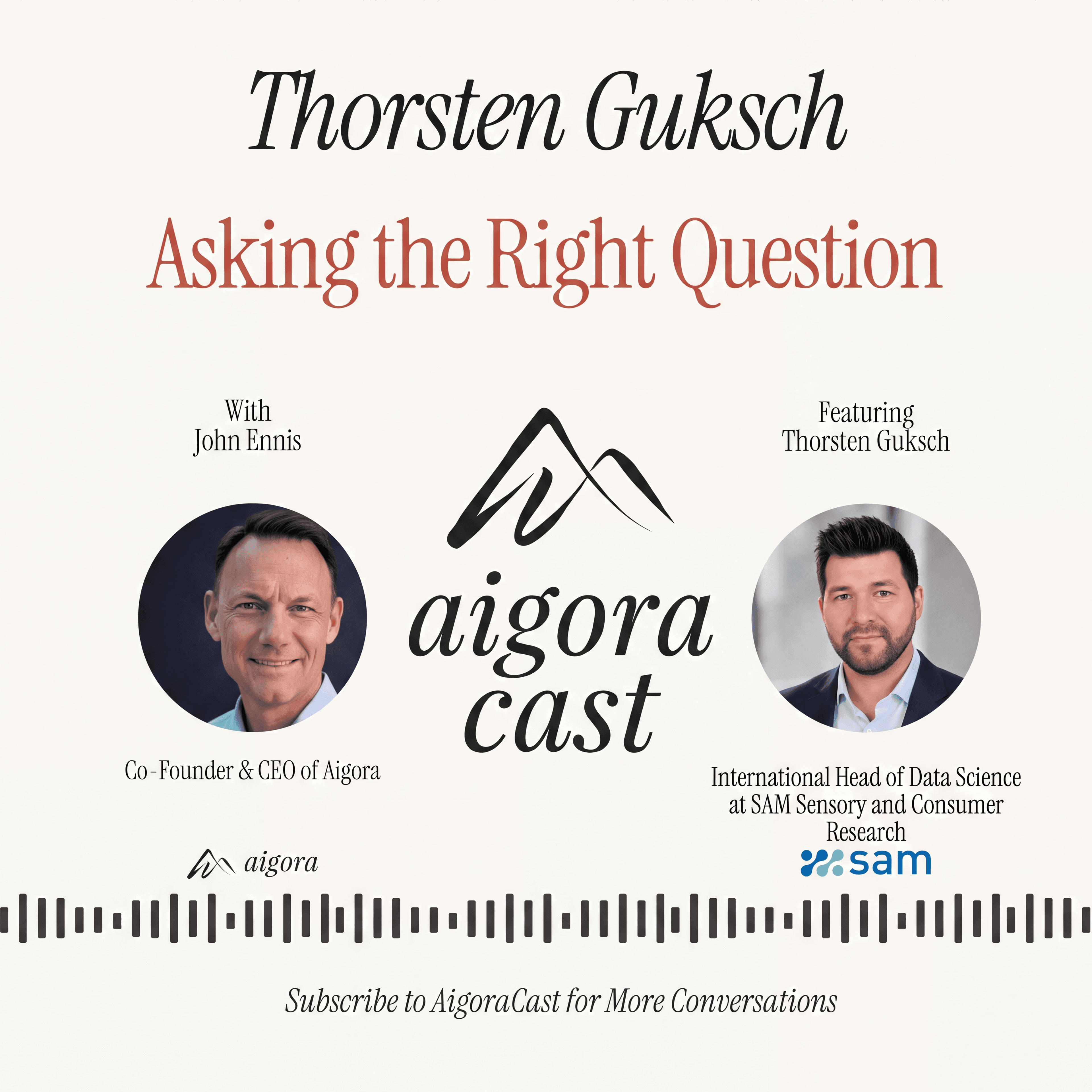
Hi, I'm Dr. John Ennis, CEO at Aigora. In this episode, I enjoyed speaking with Thorsten Guksch from SAM Sensory and Consumer Research. We talked about what happens when sensory science meets modern data science, focusing on how machine learning turns open-ended consumer language into structured sensory information, and why multisensory measurement captures product experience that a single-sense test misses. I hope you enjoy this conversation as much as I did, and remember to subscribe to AigoraCast to hear more conversations like this one in the future!
Tell us what your team is working on through our contact form. We'll review your request and reply within one business day.