AI Expertise for Consumer Insights

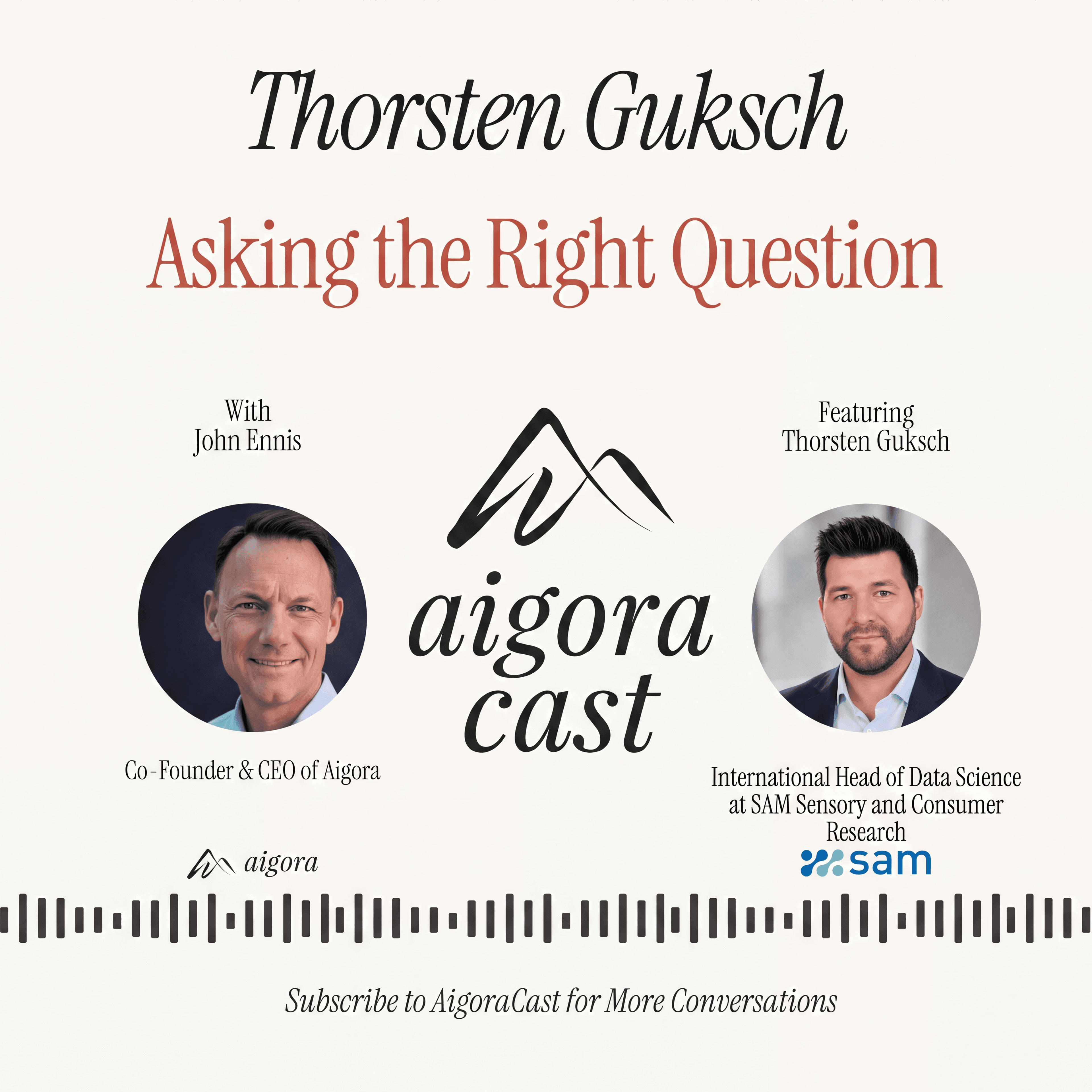
Welcome to AigoraCast. Conversations with industry experts on how new technologies are impacting sensory and consumer science.
Visit your favorite platform and remember to subscribe:
Apple Podcasts
Spotify
Please leave a positive review if you like what you hear!
Host: Dr. John Ennis, CEO at Aigora
Guest: Thorsten Guksch is International Head of Data Science at SAM Sensory and Consumer Research
Guest Bio:
Thorsten Guksch is the International Head of Data Science at SAM Sensory and Consumer Research in Zurich, where he combines sensory and consumer science with advanced data science. His work focuses on translating complex sensory and behavioral data into clear, practical insight about how people perceive and experience products.
Over a decade with SAM, Thorsten has contributed to national and international research and helped develop innovative analytical approaches. His interests include multisensory interactions, drivers of liking, machine learning, synthetic data, and automated methods for turning open-ended consumer language into structured sensory information.
Thorsten holds a Master's in Food and Beverage Innovation from the Zurich University of Applied Sciences (ZHAW) and previously studied Food and Nutrition at Albstadt-Sigmaringen University. His research and industry work bridge rigorous sensory measurement, consumer understanding, and modern statistical modeling.
John: Okay, welcome back everyone to another episode of AigoraCast. Today I'm very happy to be back again for Part 2 with my friend, Thorsten Guchsh. Thorsten Guchsh is the International Head of Data Science at SAM Sensory and Consumer Research, a global leader in the sensory and consumer insight space. Originally from Germany, Thorsten studied Food and Beverage Innovation near Zurich, where he developed an early passion for advanced statistics, even creating bespoke statistical programs in VBA prior to the modern AI era. Today, Thorsten provides strategic orientation and guidance for data analysis across all of SAM's teams in Europe and the US. He specializes in creating and maintaining robust analysis pipelines, supporting complex statistical modeling, and leveraging machine learning to extract actionable insights from historical data. A key pillar of his leadership is driving research and data innovations while ensuring the organization is applying AI with purpose. So Thorsten, welcome back to the show.
Thorsten: Ah, thanks for having me again.
John: Yeah, it's great. We had so much to talk about that we didn't have time to cover it all, so we decided to have you back for Part 2. And I think you're the first person that we've done a two-part episode with, so...
Thorsten: Ah!
John: Yeah, it's nice. Okay, so I think we won't really go into background and whatnot, because if somebody would like to know more about how you got where you are, they should just listen to Part 1. So why don't we jump back in? We have a few things that we want to try to make sure we get to: talking about embeddings, we were talking about synthetic panels... And I actually think we were having a really interesting discussion before the show on chatbots versus dashboards, and I think that's—I have seen some really interesting hybrids we've developed, some at Aigora, it might be nice to talk about that. So where would you like to start? Which topic do you find most interesting?
Thorsten: Maybe we start with the dashboards.
John: Okay. Great. All right, well what do you see, you know, you were talking about how you all personally are moving away from dashboards to more of a chat-based experience. What do you think is the right UX now for doing, say, consumer sensory analysis in the age of AI?
Thorsten: I mean, these are both serving different purposes. With a dashboard, the beauty is you have always the right design. You know what you need to look for in this chart. You are expecting already an outcome. It's easy to read, and the data updates automatically. But the thing is, what if something changes? Something dynamically, then it's a little bit more difficult to add new stuff, it's harder, and also, yeah, it is more cost—development cost. And chatting with the data, yeah, of course, you have unexpected answers in different formats. Of course, this is how you design your chatbot, but you can dig deeper, yeah? And that's also the reason I think why these chatbots are very popular in qual research, because they can act like a moderator. They dig deeper, but if you ask to dig deeper into the data, they do, and they let text down, so you get to the essence of the consumer insight. And of course, these—we know since these models do hallucinate, it's always good that they have access to the data, to the actual data, and they reference also the data. Maybe they can also show the part of the results where they claim is based on.
John: Right, right. Well, this is interesting, because I think there's this trade-off between, as you mentioned, dashboard: reliable, consistent, right? But also somewhat fixed format, and that lack of flexibility can become a problem. I mean, for something as simple as the data input format, right? That you, you know, you have—I mean we see this all the time in sensory science—inconsistent data formatting. Now that's gotten to be less of a problem over the years as you've had, you know, Compusense, EyeQuestion, MMR tools, whatever. I mean you all have your tools, so you start to get consistent data formats. But if you've got someone getting data from different suppliers, they have data that are in different formats. Those problems largely go away when you're working with an agent, right? Because as long as the agent can understand it, it can write code and... Well, there are different levels of this. A warning I would give everybody is: never let an LLM manipulate your numbers. That's a very dangerous proposition, right? What an LLM should do is it should write code to manipulate the numbers.
Thorsten: Exactly. Every data scientist I spoke to, they say, "Give me the code to do what I do." Then it's reproducible, yeah? Because these systems are non-deterministic, and then you get every time a different answer. But yes, and I remember in the early days of AI, like this ChatGPT era and so on, the first thing what researchers said is like, "They can label your columns because they understand what question was asked. They see the link." And yeah, the first thing I thought is not data analysis, it was really a labeling these columns and questions.
John: Right. That's right. And I think that that is, you know, classification type use cases for LLM are actually quite strong. And that if you have a protocol and you've got an Excel spreadsheet, an LLM will do a good job of identifying, "Okay, this column is supposed to be..." especially a modern LLM, will do a good job of classifying, "Okay, this column matches this, this column matches..." Okay, but then the next thing it needs to do is it needs to write code, because if you give a big table of numbers to an LLM and you ask it to reformat the table, man, that's a recipe for trouble. Because, you know, first off, it might make up numbers, it might do it wrong, and it's completely unverifiable. You just get some answer, right? There's no way to really check its work. It's just... that's really putting too much trust in the AI. But getting back to the kind of dashboards versus chatbots, what we've started to do at Aigora is have these catchers where, you know, you have input coming in, we expect a certain input, and a good use of an LLM is to verify that the input is actually what it's supposed to be, right? And if it isn't, what we do is we have a series of processes for attempting to repair the data. But we always go back to the user, and we always say, "Okay, look, this didn't match. Here's what we think is wrong. Here's an attempt at fixing it." But we're not going to pass that through. I don't know what your views on that are, but...
Thorsten: Yes. It's always human verified when we do something with AI. I think I spoke in the last episode about that we use AI also for data interpretation a lot, but it's always the human having the last word. And more importantly, it's always on the evaluated data. And some people tried with smaller datasets to do analysis. It can go quite good, but of course they can always make up stuff. But there is something which is pretty dangerous, and you need to know the context length of your model, because the model forgets things if the input is too long, yeah? If you have a result file which is maybe thousands of lines long, it will maybe find the core patterns, but then it will make up stuff for the patterns which are maybe a little bit weaker. And this is dangerous, yeah? So know your context length for the model, so you know is it capable in giving me a reliable answer considering all data I gave him.
John: Yeah, no, I totally agree that it's really important for people to understand the basics of how these tools work. You don't need to be an expert, but you have to have a working understanding.
Thorsten: And what we do with the model is quality checking. At EuroSense, I will have a presentation on that, where we show we use AI to check for fraudulent responses in consumer tests, because some things it's easy to spot, like speeders or the ones who click all the same answer, those are easy to spot. But if someone gives illogical answers, this is a little bit more difficult, yeah? So there AI can help because it understands the context. It understands, "Oh, this cannot be if the person said this to sweetness, but then this in jar in sweetness." So there is, yeah, this is illogical, and then the model flags these consumers. But then, again, human verified, and we do not drop consumers or maybe important information just because AI said so. It's always human verified.
John: Yeah, that's right. I think that's really good is that these softer edge cases—the way I see it is, I kind of think of dashboards as like rectangular fixed blocks, right? And the LLM is more fluid, and it can, you know, it's sort of like the LLM can round the corners of the blocks and it can help make the whole thing softer and more malleable. But I do think that without some structure that, like you said, you have hallucinations or another problem that I think is not really appreciated, because you see a lot of—you probably see this with your clients—lots of co-pilot agents now, right? People with co-pilot agents. And I think that if you're doing a focus group report and you know what your output template is and you've got a good model, you're using 3.5 or 3.6 or, you know, one of the Opus—one of the newer Opus models, it's going to do a pretty good job most of the time, although you'd be surprised at putting things in the right format. Where I think you really get into trouble, though, is when you have co-pilot agents that are doing quantitative analysis—it's doing a PCA or an MFA or whatever. And unless you have really highly specified that agent, you run the risk of getting correct but different results from different runs of that agent. Because, for example, in a PCA, right, you can scale or not scale the variables, or you can center or not, whatever. There's all sorts of choices that you can make. And unless every possible choice is specified and it's all very clear to the agent what choices it's supposed to make, even if it's writing code, it'll write different code with different choices, and you get different results. So yeah, what are your thoughts on that one?
Thorsten: This is exactly the reason why I said before that we do it only on the evaluated results. Of course, AI can be capable of doing a penalty analysis, but it will completely rewrite the code from scratch before giving the answer. And of course, things can happen. Design choices can be happening, yeah? And we know that also in penalty analysis, there are different philosophies and different settings, different algorithms, but all call it penalty analysis, yeah? And this is the big risk. So we analyze the data first with our tools that we know they are right. And then we have a lot of results tables, and then we take AI to find the needle in the haystack.
John: Oh, very interesting. Yeah, I think that's a good approach. We have a little bit... we have this new concept of "dashboard on demand" that I can show you later. It's pretty cool. But our... yeah, one approach to a data science agent is you just run lots and lots of analyses and you analyze it, and I think that's a valid way to approach this. What we have now is an approach where chatbot interface, you talk to the user, "What are you trying to do?" And then we have lots of different modules for doing analyses that are now like—they're hardcoded. It's like a dashboard now, it's got that rigidity, but they're small pieces. And the agent will assemble the analysis plan, right? User signs off, and now, but it's like a highly managed experience where the agent is going to go through these steps, but the agent isn't making any choices. The analysis plan is laid out, and now we're going to run this. "Okay, looks good, great." Now we're going to run this, "Looks good, great." But I think that you're going to see more and more of these hybrid solutions where it'll be part dashboard or part backend code, but then there will be a freedom that comes from the LLM. And I think that it's a big exploration right now to like figure out what's the right form factor.
Thorsten: Yeah, that's very interesting. I'm always open for that, and as long as the end user—what we want to communicate the results to—has a good experience, I'm always in favor in that to have good experience and get the insights, and maybe also play a little bit with the data, because not all are data nerds, yeah? But yeah, a little bit playing with the data, digging deeper, it's always fun.
John: Yeah, very interesting. Okay, well we were going to talk about embeddings I think next. We need to wrap up that topic and then we get to synthetic panels. But let's just take a short break and then we will be right back.
(Break)
John: Okay, we're back. So let me now talk about embeddings. So this is I think a... One of the reasons that I like you is that you're one of the only other people in sensory science, except for maybe, you know, Sebastian, maybe Thierry, maybe a few other people out there, who are actually thinking about embeddings. So what is it about embeddings that you think are so interesting?
Thorsten: It's fascinating me because what's encoded in the embeddings... Or maybe just to explain the viewers what embeddings are: embeddings are numerical representations of text. So if you have a word or a sentence, it gets encoded by a model into a fixed length number, let me say 1,000 numbers, yeah? What each number means, nobody knows really! But what we know is that sentences or words which have a similar meaning, the vectors are pretty close to each other. For example, if you have something like "texture" and "creaminness," they are more related to each other than "texture" and "vanilla," for example. Because these encoder models, these embedding models, they are pretrained like these AI models—these are AI models, but just one part of the brain of the AI. They are trained on text, so they know—they learned what this word means in the context. So it's like a snapshot how the AI understands our text, and then it outputs as numbers. So it maps text to a highly dimensional space to capture the semantic similarity. So what is the actual meaning of the sentence? And this is how AI models work in the background. But I was thinking, this is an interesting topic. You used it as well, John, for RAG systems. So you embed documents based on their meaning, so I can easily retrieve them because I know, okay, there was something about creaminess in this report, so I can extract it. But I was thinking, why not directly calculate with these embeddings? So first, in Sensometrics, I presented an easy workflow to embed text into categories. But LLMs are better in that because it's just a snapshot of the meaning, but the LLMs understand the context. They can build much easier the categories, as you said before—classifications, they're very, very good in that, yeah? So LLM wins here. But of course, both win against human coding because it's very labor intensive. But the interesting part about these embeddings is they don't capture keywords. If a person said, "I like the texture AND the vanilla flavor," it gets encoded as texture and vanilla together. So if you would have the keyword information only, you count the number of mentions for vanilla and the number of mentions of texture. But here you have both together encoded, so you have compositional meaning which gets captured. And this is interesting. And in an upcoming conference in Agrostadt in Dijon, I will have a presentation on drivers of liking made from these embedding models, to see which semantics or which semantic structure is related to the liking or to the disliking.
John: Mm, very interesting. What I like about—I mean cause I really think, you know, I've done stuff with embeddings. I've been interested in, you know, you have encoding and you have decoding, right? Where you... because one of the things I'm interested in is, you have two text descriptions of products, okay? And kind of a typical situation would be: you have some sort of multidimensional mapping of the products, you have a product space, okay? And then you identify a white space, and you'd like to know what's in the white space. And the problem that I was interested in is, I've got descriptions of all these products and I have their locations. Can I get a reasonable description of what's in a white space by going from the coordinates back to the text, right? That embeddings, as you mentioned, allow us to go from words to numbers, that's the encoding; the decoding is the opposite direction.
Thorsten: Yeah.
John: And I played around a lot with that, and I ultimately decided an LLM-based approach was better. But what I liked about embeddings is the determinism.
Thorsten: Yeah.
John: That they really are building blocks, because they've been all pretrained, but when it's done, the same phrase gets the same numbers out, right? And that means—and they can be run locally, that's another huge advantage! These are not giant models that, you know, have to run on a GPU or whatever, or a cluster. They can run on your local machine. You can download them and you can run them.
Thorsten: Exactly. They are very cost effective. I have several embedding models running on a laptop, and these are seconds, yeah?
John: Yes. So if you're interested in the relationship between words and numbers, which is obviously highly relevant to our field, and I think LLMs have made huge progress in that area, the building blocks of that are the embeddings. And if you're going to do something that's more controlled and reproducible, I do think embeddings are a really good area to play in. And I think contextual embeddings especially, really interesting, because what does "green" mean, right? It means one thing if you're talking about grass, it means another thing if you're talking about, you know, a young person is green, they don't have experience, you know? Like the contextual embeddings are very interesting. But I do feel like this is a really exciting area of research, and I'm glad that you're leading—I think you're really like probably the leader when it comes to use of embeddings in the field. Maybe a few other people, but I think your research on this is really interesting.
Thorsten: Yes, and I think this is a great opportunity, especially if the costs of these large language models are going to be higher, I guess, in the future. So this is a cost-effective alternative also.
John: Yeah.
Thorsten: And the deterministic part: each word has its place in this high-dimensional space.
John: Yes. And from a resource perspective, it's a huge advantage to a big company that these embeddings—the embedding models or the embedding functions—can run on local machines. They don't need to have GPUs, they don't need to send their stuff outside, they can just run it locally and they can get a lot of the benefits of going back and forth between words and numbers. So it's very good. Okay, we've got 10 minutes left, so let's have the last topic that we need to discuss, which is synthetic panels. So what are your thoughts on synthetic panels and synthetic data?
Thorsten: Yeah. Yeah, I think we talked about last time a little bit on that, and my opinion did not change in the meantime. I think it's a good idea if you have a strong foundation of data.
John: Right.
Thorsten: But if you train for—again, there are two fields: one with AI chatbot models like ChatGPT or Copilot, and then the other route is really with machine learning, yeah? Running machine learning models, they learn the structure, and they can replicate based on learned distributions. For the first one, I think it's very dangerous that the model makes something up. Of course, it is also the goal that they learn the structures, and then based on their experience, on their training data what they have inherently, that they give you new and richer—richer output. But we don't know if this is grounded in reality or just made up. So I'm very hesitant to use that. I think it's good to play around with it, but it needs to be verified also with the data you have. And unfortunately in sensory we have only small to mid-sized datasets, and then we need to be very careful when applying this second method, the machine learning approach. Because in Pan1, I showed that we had a study where we had no significant differences in a project, but then after creating synthetic responses on it, since there are learned distributions, the results afterwards were highly significant. But I just gave it a part of the dataset, so I had the rest of the dataset where I could verify. And by having the full dataset, the results were significant, but in the other direction than the synthetic data was significant. So with having too less data, you have a big risk to capture the wrong information, or too few information, and yeah, you need to be very, very careful in the amount of dataset, and if the data is already pretty strong and significant. But then it's a question: what's the point on synthetic data if the results are clear?
John: Right.
Thorsten: But I think there is more to that, that you can model certain scenarios, but still you need to be—you need to have a strong foundation in terms of data.
John: Yeah, no, I totally agree with that. I get really nervous when I see people trying to combine synthetic data with statistical analyses. That it's... I know that from a marketing perspective, it sounds great to say that you're going to do a study with 50 people and then have the power of a 200-person study. Yeah, that's great. That would be wonderful if you can! However, that's very dangerous because you don't really have new information, right? You just have the illusion of new information. Now, I do think that you can recombine insights from different piece—you know, you do a study, you have one bit of information here, you have another bit of information here, a third bit here. LLM is very good at recombining, and in that way, it can help you to understand what you already know. But then that brings us to your first point, which is the extreme importance of verifiability. That you must, if you get an interesting result out of a synthetic experiment, you have to be able to drill down and figure out where is this coming from, and have named sources where you say, "Okay, this result is coming from the combination of these three things that we can verify are true, and we can verify for ourselves that combining these three things together gives us the insight." And if you don't have that level of precision, I really think that you shouldn't trust it at all.
Thorsten: Yes, especially in combining information, as you said. By having a big pile and having the AI finding the needle in the haystack, you need to verify if what the AI found, it's really a needle and not a piece of garbage, yeah? So it's very important to verify.
John: Yeah, that's a good way of putting it, yeah. It's very tempting, you know. I often get this from clients where they want to see that, you know, an approach has been validated, okay? And I would say even if it's the case that someone has done research, they have an approach—basically a black box approach—and it worked in the past on these examples, I don't think that says very much about how well that black box will continue to work in the future. You know, I mean I've seen this with all sorts of companies where a company will go out there with a whole ton of questionable models, and they'll have 20 clients, right? And then by luck, five of the clients will have happened to have gotten directionally good info—it's a little bit like the stockbrokers, right? Where you send stock tips to 100,000 people, and half of them are right this week. So next week, the people that got it right, they get their stock tips, and after a little while you've got a group of people for whom you've been right 10 weeks in a row, and now they're ready for a big bet. Well, you know, even if the model is working, I think if you don't have that extra layer of scientific rigor where you can investigate the model, you can see that it makes sense, it's consistent with what you've already learned... Yeah, past performance is not the best predictor of future success when it comes to modeling. You really do need to have a scientific underpinning, or you're just...
Thorsten: Exactly, and give it the information it needs and make sure that it uses the information. Guardrails for it. The more vague the prompting or the system prompting is, the more freedom you give the AI model, and then of course the answers can vary a lot, yeah? So guardrailing is also important. So what we do at SAM, when we do the interpretations, we give the AI our values how we would interpret the data, so we get very consistent results, yeah? If you just say "What's in this study?", you run the same prompt or request again and then you get different results. Of course the core will be mostly the same, but yeah, you get different results instead of saying, "Okay, you need to read it like that, you need to evaluate it taking this and that into consideration," then you have much more stable results.
John: Yeah, I agree. I mean, ultimately, you know, there's a big drive right now to try to pretend that these models are people and they're having consciousness and stuff. I think that's just not correct. It's tempting—I mean, the models are trained to act that way and to give you the idea that they have, you know, feelings and concerns, but they don't. They're just matrix... matrix multiplications.
Thorsten: And they're confident in what they're saying! This is even more dangerous. A human would say, "Okay, it's right," because they seem so confident.
John: Yeah. No, it's very dangerous, honestly, because it really gives the illusion of something that it's not. But I do think that when used properly, these tools—and they have to be used strategically and properly and along the way as part of a scientific pipeline or workflow—are very powerful. So what final advice do you have, because, you know, I could talk to you forever, so let's... time goes by so quickly! What final advice do you have when it comes to using AI in consumer research?
Thorsten: Yeah, I think a lot of the advice I already shared, but to summarize: always grounded in good quality data, so evaluated results is the best; give it the guardrails so how to read it, so you have more robust and reproducible results; always be cautious and verify with a human, verify with human that it makes sense, yeah?
John: Yeah, totally agree. I think we have to remember that the goal of all this scientific research is like increase our understanding, right? It's not just to get results that are right or wrong. It's to increase understanding, that's like the point of science. And I think if AI is helping you to do that, great, you know, but it's not magic. It's a tool to be used.
Thorsten: If there would be an advice for a sensory scientist: 5 years ago, I would have said learn coding so that you can test a lot of things. Now, AI does the job for you, it does the coding, so you can focus on that what really matters, because this is just the heavy lifting. Because I think you said that also before: asking the question is the most important thing. Without the question, AI does nothing, yeah? It gives you a result, but you need to ask the question, so you can focus on that. You can learn about different fields which are related to sensory, and there are a lot of fields which are related to sensory. Take that opportunity to learn and connect, asking the right questions, and let AI do the heavy lifting for coding so you can test your hypothesis.
John: Yeah, I totally agree, and that's where I know there's a lot of fear about AI and job loss and that kind of thing, but I think only a human can really know what the right questions are to ask, because life involves lots of trade-offs, and the more problems get solved, the more new problems there are to work on. And which of those problems are important? If you don't have some values, if you don't have some internal sense of what matters, then it just becomes a bigger and bigger problem space. So I think humans are going to have a lot to do!
Thorsten: It opens doors to new problems! Yeah, it's like a tree. Humanity has now more capabilities to do more research in more fields where the hurdles in the past were too big, yeah? Now it's easy.
John: That's right. And so then now new things are hard! Things that were impossible are now hard. And so you work on those, and it just goes on forever!
Thorsten: But you can have an army working with you together on that problem!
John: Yeah, that's right. A world without end, do you know that from Ulysses? From Joyce? In chapter 4, Stephen Dedalus is walking on the beach and he closes his eyes and he opens his eyes—he's wondering, "Does the world go away when I've got my eyes closed?" And then he opens his eyes: "There they are, all the time without me, world without end." Is it in Ulysses? And the idea is it just goes on forever. It's always there, the world goes on forever, there's always new stuff to do. Don't worry, as long as you stay curious and you... yeah, everything's changing, everybody's jobs are going to change, you know? Mental manual labor is going to get automated. It won't be anybody's job to reformat Excel spreadsheets anymore. That's just not going to happen, right? But there'll be new, more interesting jobs, right? Did anyone really ever like spending their whole day reformatting Excel spreadsheets? I doubt it! Maybe some people enjoyed it, but... People used to dig ditches for a living, and now people don't do that, you know, they use machines.
Thorsten: It's transforming jobs, yeah? Things are changing, and people need to adapt, and they will adapt, certainly, because we also thought, "Okay, nobody will work anymore with the internet," but of course, it transformed the way we communicate, it transformed the way we work, but yeah, we're still here and there are new challenges every day. And I'm excited about the future, what will come and what AI will else enable us to do.
John: Totally agree. And a small note of correction: I said Telemachus, I meant Stephen Dedalus. Dedalus is the main character in Ulysses, so... Okay, great. So if somebody wants help, guidance in this area, they'd like to reach out to you, what are the good ways of getting in touch?
Thorsten: Yeah, over LinkedIn. It's Thorsten Guchsh at LinkedIn. Drop me a message, and we can connect.
John: Okay, great. We'll put that in the show notes, and we'll also put the SAM link in the show notes as well. All right, Thorsten, pleasure as always. Thank you very much.
Thorsten: Awesome, take care.
Thank you for listening to Aigoracast. If you enjoyed this episode, please subscribe and leave us a positive review on iTunes. To learn more about how Aigora is helping businesses leverage artificial intelligence in sensory and consumer science, visit us at www.aigora.ai.
Aigora is a contributor to the Aigora blog, sharing insights on AI-powered sensory science and product development.

Anshul Dubey joins John Ennis to discuss practical AI adoption, helping skeptical teams, and using AI as a coach to strengthen human thinking and skills.

Hank Margolis joins AigoraCast to discuss building Zevia, improving formulations, earning trust, and staying open to changes in the beverage market.

Welcome to AigoraCast. Conversations with industry experts on how new technologies are impacting sensory and consumer science.
Tell us what your team is working on through our contact form. We'll review your request and reply within one business day.