
Enterprise research
Expert transcripts turned into a quantitative product map
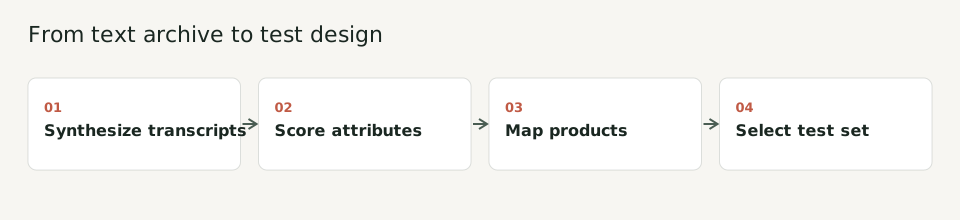
We converted the transcript archive into a scored product matrix, built a multi-dimensional map from those scores, and chose a product set that covers the space for the consumer test.

Evidence at a glance
- Evidence type
- Delivered analysis
- Organization scope
- A major CPG company
- Documented boundary and output
- This case covers the delivered analysis: transcript synthesis, attribute scoring, the product map, and product selection. The company and category stay confidential.
The situation
Expert evaluations lived as transcripts and free-text notes. The team needed scores they could compare across products before consumer testing.
The archive held expert qualitative evaluations across a large product set. The open technical problem was how to turn that text into a stable scoring matrix, a map of the product space, and a selection method that maximizes coverage for a later consumer test.
The approach
Synthesize the expert record
Each product got one audited description built from the source transcripts, with every claim checked against the text before acceptance.
Find attributes and score them
The attribute set came from the expert language itself. Every product was then scored on a shared scale, with a compliance audit on each attribute.
Map the space and pick the set
The score matrix became a multi-dimensional product map. From that map we selected the subset that best covers the space for testing.
System or method for this case
What we delivered
- One audited product description per sample, grounded in the source transcripts
- Attribute catalog induced from expert language rather than a fixed lexicon
- Shared-scale score matrix with compliance checks on every attribute
- Multi-dimensional product map from the score matrix
- Spread-optimal product subsets for consumer-test design
Technical pieces
Transcript synthesis with expert-in-the-loop audit, Attribute induction from source language, Roster-anchored scoring, Dimensionality reduction for the product map, Combinatorial selection for coverage
What changed
The team left with a scored product matrix, a multi-dimensional map from those scores, and a product set chosen to cover the space for the consumer test.
Discuss a comparable system
Bring the research question, data boundary, and decision the system needs to support.