
Loading article
Loading articles
Loading articles
Loading article

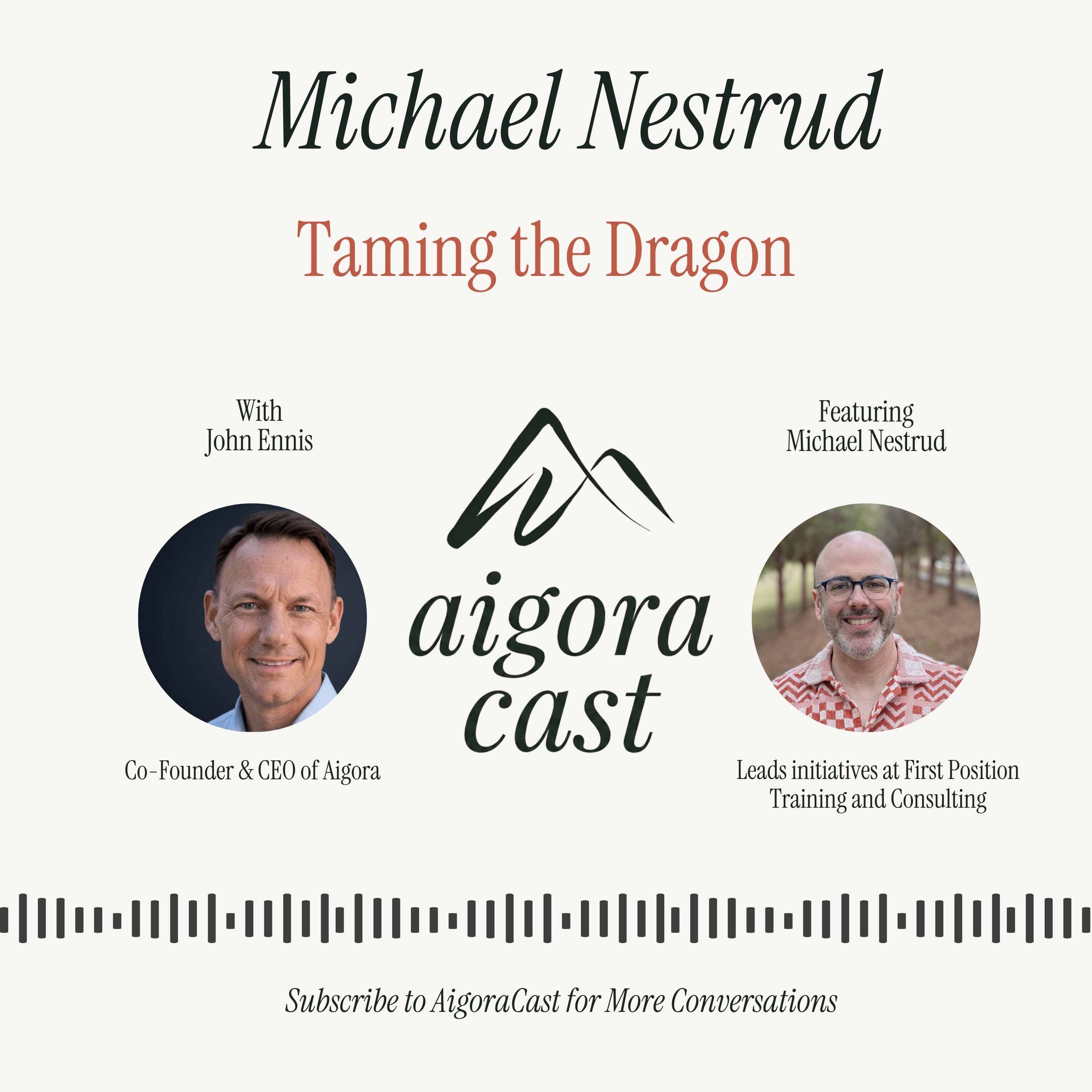
Michael Nestrud is a sensory scientist and culinary arts professional dedicated to exploring and enhancing the human experience through food and product evaluation. He currently leads initiatives at First Position Training and Consulting, operating on the core philosophy that product evaluation and sensory science should be accessible to everyone.
With a unique background that spans the scientific measurement of human perception and the culinary arts, Michael helps organizations build foundational knowledge and practical skills in product testing. His work focuses on translating complex sensory methodologies into approachable, actionable training for researchers and product developers alike.
John: Okay, welcome back everyone to another episode of aigoracast. Today, I am very happy to have my longtime friend, Michael Nestrud, on the show.
Michael Nestrud is a sensory scientist and culinary arts professional dedicated to exploring and enhancing the human experience through food and product evaluation. He currently leads initiatives at First Position Training and Consulting, operating on the core philosophy that product evaluation and sensory science should be accessible to everyone.
With a unique background that spans the scientific measurement of human perception and the culinary arts, Michael helps organizations build foundational knowledge and practical skills in product testing. His work focuses on translating complex sensory methodologies into approachable, actionable training for researchers and product developers alike. So, Michael, welcome to the show.
Michael: Thanks, John. It’s great to be here.
John: Yeah, it’s awesome. We’ve known each other for quite a long time, so we have a lot to talk about. I’m sure we’re not going to have any shortage of topics!
Michael: I know! I think we probably met in 2006 or 2007?
John: Yeah, that’s wild. Yeah, it’s amazing—almost 20 years. All right, so just to get people caught up—because, you know, I think most people know of you, but it would be good if you went through your background, how you got into sensory, your professional journey, and what you’ve been thinking about recently.
Michael: Yeah. I’ll start with how I got into sensory. You know, I grew up in the '80s and '90s. As a kid in the '90s, there were some technology projects I was very interested in back then—which might surprise some of you. One of them was a pre-internet project where I built an online community in my bedroom where people could call up, communicate, and chat with each other.
I was always kind of interested in this idea of connecting people, working with people directly, and so on. One of the ways I also did that was through food at the same time. I had these two hobbies: computers and food.
When it was time to go to college, I didn’t know that food science existed. This was the late '90s. Even though it did—and actually Arkansas, where I grew up, has a great program—I didn’t know that. Again, information pre-internet was not easy to come by. It’s hard to imagine now. We had internet, but still, it was hard to find.
So, in a very transactional sort of way, I was like, "Well, there’s more money in computers than food, so let’s do that." Two and a half years into a Georgia Tech degree, I took a step back. I loved that part of my training, and I love Georgia Tech, but I sort of realized—especially after opening my eyes to the world a little bit—that I could do food, computers, and all of those things together.
I left Georgia Tech and went to the Culinary Institute of America. I got a two-year degree in culinary arts and taught there for a year. I followed that up by following the path of a good friend, Chris Loss, who is now at Cornell. He showed me that you could do culinary and food science together. Even before that—we're going back to 2005—it was Chris who introduced me to Harry Lawless.
When I learned food science existed, I didn't know sensory science existed. Sensory science appealed to me because it went back to that community-building aspect: the idea of focusing on people and working with people directly. Even though I have this technology background and I love food, for me, what brought me here and what has kept me here is the focus on people—both the people in our field and the human experience of the people we research.
That was about the time that we met. I was working on my PhD work, and you all had invited me out to the Greenbrier back then, which is still a memorable experience. It was a highly memorable experience back then, definitely. I still want that bread pudding! We found that we had overlapping interests in some of my PhD work.
We worked together on a number of projects. I ended up going to Natick Labs; my capstone project involved the Army, so I did a postdoc at Natick Labs following up on some of that research. I found my way into industry shortly thereafter. I worked at a number of companies: a small consulting company doing market research, and then Ocean Spray, leading their sensory science team for six years. I was independent for a bit along the way, and then my most recent role was as the VP of Innovation for Curion from approximately 2021 until 2025.
John: I see. And so now, you’re doing your First Position Training?
Michael: Yeah. Now I’m kind of in this funny place. It’s very interesting to me, having had the perspective that I’ve had of the field—the breadth of the field, the economics of the field, the client side, non-food (I love non-food, I got tons of non-food experience in my previous role).
Taking stock of that in the past year, it has let me realize a lot of the biases that I’ve had. Where I’m at now is, officially I’ll say I’m retired, but I’m not out of the field. I’m not not doing anything in our field. But I’m very interested in approaching our field and helping our field from a slightly different perspective than I have for the past 20 years since we met.
John: Okay. So what have been some of the changes in your thinking over the last couple of years?
Michael: I think that one of the biggest challenges that our field has is... and when I say "our field," I feel like I need to define that, right? Because I’ve defined myself as a food scientist, and I came up through the food science track. But sensory science doesn’t belong to food scientists by any stretch of the imagination. Sensory science, to me, is something much broader than that.
However, what I see right now is our field closing itself off instead of opening itself up to some of these other ideas. The biggest change in perspective for me now is that I see very clearly the influence that businesses have had on the way we look at what we consider some of the fundamental basics of our own science. I kind of view that as the tail wagging the dog a bit. This is the area where my brain has been for the past year and a half: looking at the unintentional and, quite often, what I think of as negative consequences on the science itself and the health of our field due to this sort of backwards influence that has been baked into our field since almost the beginning.
John: Now, one thing that comes to mind for me when you bring that up is the emphasis on liking. Management very often wants a metric, right? They just want a number. They want to know, "Okay, we’ve got this benchmark. Are we beating the benchmark? How are we doing against the competition with respect to this benchmark?" And so they somehow landed on "liking" as the metric that they prefer.
It does seem like there’s this obsession with liking. You see this at every conference; there's always the idea that we need to go beyond liking, but then at the end of the day, you meet with clients and what are we working with? It's liking! Or purchase intent, sometimes. Is that the sort of thing you’re talking about? What do you mean by that business influence?
Michael: I think you're picking on one of the biggest ones that is problematic for our field: the over-reliance on overall liking.
Scientifically, if we were looking at whether liking is the right measurement tool on a case-by-case basis, and we had good alternatives... which, outside of food and non-food, I think they've done a great job because they avoided liking, and that's been their saving grace in all of this. They’ve developed all sorts of other ways to measure the experience: expectations, fit-for-use, applicability, "does this face cream accomplish what the claims say it does?" There are all sorts of different metrics that are used outside of food. Within food, we haven’t even explored that space. It’s just liking or almost nothing.
That, to me, is extremely problematic. As a scientist, I’m like, if you’re working in the commercial world, your company wants to make money, and we for a fact know that higher liking does not always correlate with dollars.
A very simple example of that is—we all have memorable liking scores, right? I saw a 3.5 and change on some candy once. I was like, "Woah, that’s one of the lowest scores I’ve ever seen, and on candy on top of that!"
I was doing this tasting with a group at a company, and it was a roundtable of scientists. They were all sort of poking fun at the product. "I can't believe it's this low," and, "Oh, this is disgusting," and all this stuff. I happened to grow up with this product, so I knew that it had been on the market for about 40 years. I was like, "You know, this product has been on the market for over 40 years, and I suspect that any one of us would love to have a product that we launch today that will be on the market 40 years from now."
John: Right. What was this product? Do you remember which candy it was?
Michael: Yeah, it was Gushers.
John: Gushers! [laughs]
Michael: If they weren't disgusting, it wouldn't work! It wouldn't work! So, it’s kind of a goofy example, but it’s just like I’ve disproven that overall liking is the right metric always, right there. Yet our field continues to latch onto it.
I’m very interested in first exploring the history of overall liking—I've been having some conversations around it to understand how we got here on the food side. Ultimately, I want to help and encourage our field to look beyond it.
Actually, there’s a bit of a dichotomy. There are people who say our field is very healthy, and there are people who say our field is not very healthy. I sit somewhere in the middle, but I lean toward "we are kind of not healthy at times," especially if we don’t change things. I think a big part of that is, deep down, the businesses know that overall liking is not predictive because we get challenged on it so frequently. We get challenged on it so much, and rightfully so at times. A lot of times, those challenges we get from the other side of the building—from the marketing department, other R&D leaders, or whoever it is—a lot of times they’re right.
A lot of times when consumers call in about product problems, they’re right. Most of the time they’re right, actually. So, I keep coming back to: why liking? I had dinner with some sensory scientists earlier this week and I asked them, "What is liking? What does it actually mean?"
When I’m sipping this coffee on a day-to-day basis, I’m not thinking about liking in the slightest.
John: You know, I have a hypothesis on this. I think that one of the problems that plagues especially American companies is constant reorganization. I think, honestly, you've got these executives, MBAs, big salaries, and they have to justify their existence. So they are always reorganizing everything, right? It’s like, "Oh, we were open-office, now we're closed-office." Then an article comes out in Harvard Business Review that says open-office is better, so we're back to open-office. Whatever.
It’s also a lot of moving around. You have a lot of managers who are just jumping from role to role, and they don’t have time to do anything subtle. They’re just showing up, and they might have nice ideas, but at the end of the day, it’s hard to get off this number which has just been around. It's a little bit like p-values, right? Where it just is accepted. I feel like the lack of depth just leads to liking. They need a number, let's just go with this number.
One of the things I really like—you know we have a partnership with InsightsNow—one of the reasons I really like working with them is I feel like they do a good job of trying to understand the comprehensive human experience of the product, as opposed to just liking. They look a lot at reaction time, for example, and they look at the different need states that are being met.
It’s tricky because as soon as you start to open up the research to all these different variables, now you have a multi-objective optimization problem. Those are way more difficult to deal with. At some point, somebody has to decide, "We’re going to balance it like this," and it’s hard to manage. So you just end up coming back to the thing that’s easy, even if it doesn’t work.
Michael: Even if it doesn’t work! It’s like it goes back to: what is the real human experience you’re trying to measure? Is an out-of-context measurement of liking and 40 other variables of the product in a stark white booth, with three products back-to-back—is that experience that we put people through for throughput (for economic reasons, it's cheaper to run tests that way) actually predictive enough? I’m not going to say it’s not predictive, but is it predictive enough of what the businesses are asking us to deliver?
It’s hard to solve a multi-objective problem. Inside our brains is the biggest, hardest multi-optimization problem that exists, and that's the true state of the world. If we want to predict the true state of the world in our brains—which is our decision-making processes—then we have to not be afraid of complexity.
I want to touch on something you said about InsightsNow. One of the things that appealed to me about them very early on—and it took me a long time before I could get a project off the ground with them just from getting it sold into the right people—is they kept up-to-date with modern psychology and how it was evolving. I think that’s extremely important.
I look at where our field is today. I’ve had the pleasure of seeing volume in doing data analysis and seeing literally hundreds of thousands of sensory tests and the types of questions that are going into them. What I can tell you from that is the biggest thing to hit sensory science—certainly in my career, and it predates my career—is JAR scales in 1997. That is our current toolkit at scale. I’m not saying there are not pockets of people that aren’t doing some really innovative stuff, like your company, but the vast majority of our field is still stuck in a 1997 innovation world.
Why is that? What was the state of psychology at the time? We didn’t understand emotions near as well as we do right now. We certainly didn’t understand the role of emotions in decision-making processes like product choice. Yet, we’ve shied away mostly from understanding emotions—which, to me, is the part that context really screws up: any sort of understanding of emotions and how emotions fit into the environment during a decision-making process of, "Do I want to consume more of this, buy it for my family, put it on my face," whatever it is.
InsightsNow has kept up-to-date with it; they have psychologists on staff. Our field has not. I think that alone is one of the big challenges with our field. You’re a mathematical psychologist, right? If I recall, is that your training?
John: Well, I have a PhD in differential geometry, and so I did my postdoc in computational neuroscience.
Michael: Computational neuroscience, okay. But again, a field with extreme importance and understanding to sensory science, because we don’t have a lock and key on the human experience within the field of sensory science at all. Yet, I think for the most part—and I’ve heard this from a lot of people—if you don't have a food science sensory science degree, you're treated as an outsider. Which is crazy to me.
John: Yeah, I got back-doored in through my dad. He has a PhD in food science.
Michael: Yeah, but no one questions your credentials to speak in this field, and no one questions Danny’s experience. Who cares if you're called a sensory scientist or not? You're solving problems that the field approaches.
John: Yes, no, I agree. I totally agree. It’s really interesting because I don’t know if you had a chance to read my article on AI and sensory science. I think that AI is a godsend to us because it helps us with what you're talking about: knowledge synthesis. You’ve got all these different sources of information, and I think in traditional data analysis, it’s hard to make sense of all this information at the same time.
AI gives us a chance to start to synthesize lots of different sources of information quickly, even down to the level of creating agents that are informed by your research that can then represent different perspectives. Something I’m pushing hard in our AI course is: I think we should be doing a lot more with point-of-view presentations. Have a presentation, pick a person, let them represent a perspective, and have them appear throughout the presentation sharing their perspective, in the hopes of doing more than just, "Here are the numbers."
So what are the things that you’re seeing with AI? I know you’re doing a lot with AI—you've automated your whole house there with Claude Code!
Michael: [laughs] Yeah, it’s amazing what you can do when you have free time. Lights, water... yeah, I’ve got Claude Code running in the background right now trying to decode the communication algorithm to my intercom.
John: [laughs] Yeah, that’s great. So what are the things that you’re seeing with AI that you think are most interesting, exciting, the opportunities, things that work?
Michael: I believe in AI, I use AI. I do not think AI is political in and of itself, so I don't take a political stance on it. As a scientist, it’s the same thing: I think the science exists and it’s the people that either use it for good or use it for evil.
With AI, there’s tremendous opportunity to scale the impact of what we do. Where I have seen probably the biggest early impact at scale is with open-ended research. At scale, AI synthesizing open-ends was something that I think most researchers in our field who had access to AI at their work was able to use to get more information from those verbatims than ever before.
I think that's a perfect example of taking complexity—real signals, complexity, a little bit of messiness—and helping ensure that every consumer who spends the time to type in that text box and tell you information has an opportunity to be part of your analysis.
That is a perfect example of the power of AI because I know from 100% experience that spreadsheets of open-ends do not get read. They get filtered, people search for a term so they can show a nice quote to the executives, or if there's a problem they're looking for they can maybe data-mine it with the search box. But rarely does anyone read through all of them, and certainly, they aren't very good at synthesizing them.
Take that, which is a slam-dunk use case for LLMs and AI, and now it’s like: what are the other things that sensory scientists do or have practice with that we can actually use AI to move the needle on?
The dark side to this is that it puts a much, much, much more importance on the methods we're using, the questions we're asking, the response variables—are we designing the test the right way? Because a lot of what happens with AI is you abstract away some of these details, which is part of its power. We don't program using machine code and ones and zeros anymore, so abstraction is good. But if the details are being managed by economic realities of efficiency and not by the best science, and we dump all those details into an AI tool, at the end of the day, you’ve got to have some sort of validation.
What am I trying to predict? I don’t mean liking; I mean companies care about money, sales, usage, volume, cases. These are the metrics that matter to the businesses. If we want to increase our influence, we need to be predicting cases.
I did some stuff shortly after my postdoc where I was playing around with neural nets just so I could understand them a bit better. I think of AI as a bit like a neural net on steroids, even though I don’t know that that's exactly what LLMs are. But being able to synthesize and find patterns and relationships among a lot of information is something that I think AI is very good at right now.
The other thing, though, is if our field isn’t doing something now—even in a slow, deliberate, maybe-it-takes-a-month-to-pull-together-an-analysis sort of way—it’s hard to imagine that someone’s going to be able to just take AI and adopt it and all of a sudden become a master analyzer. You kind of have to have good practices before you adopt the tool so that you can manage the tool to deliver what you need it to deliver in the right way. I think that’s also something that still requires the human to know the science, to know the application, to know the domain, to know all the things, in order to be able to judge the worthiness of it.
John: Yeah, I totally agree with that. You know, I was just at Sensometrics, and you could see AI starting to come up. There were quite a few talks that involved AI. But I think that the message I was trying to get across—and you’re getting at the same point here—is people need to see AI as a tool.
What do we mean by AI? There are lots of models, lots of choices, lots of ways to prompt, lots of contexts. People need to see them as precision tools where you’re going to intentionally use AI in a particular place in your analysis, in your design, whatever. It’s not just some magic machine where you dump stuff in the top and out comes whatever you want on the other side. You have to... there's still, I think, an even bigger need for humans now to plan and to validate, as you mentioned with the validation step. You have to—and in the AI course that I’m in the second cohort of now, I talk about being a "dragon tamer." You’ve got this powerful thing, but you have to tame it. You have to be in control of it. You have to take little steps, and we're going to use AI to do this, then the next step. We're controlling the workflow; you can't just let it get away from you, because pretty soon you just get slop. It all averages out and you lose all the signal.
Michael: Yeah, very much. I struggled—I don't want to say struggled, but I did a bunch of work in the early days of LLMs when it was kind of a free-for-all, and built some stuff with personas. What those did was take a single dataset—instead of a lot of datasets like a segmentation—and create a persona off of it based on some sort of liking cluster. Then you can create personas and sort of pit them off each other. You can have them tell why they like each product versus the other products, and really do some really interesting stuff there.
I thought this was fascinating and huge for storytelling, and I’m thinking back to my client-side days, I would have loved this. But there’s been struggle with uptake with that. I’m going back two or three years, but there was struggle with uptake.
I’m kind of going back to: why was that? Because I agree with you, I think it’s fascinating. The answer is storytelling. R&D people want data, and sensory scientists want to see the tables of data and numbers. A persona is a representation of a human, and they’re not telling you, "Here’s the liking score that solves the question," or, "Here are the JAR scores or JAR penalty scores." The persona is about storytelling and influencing with data.
If a team doesn’t have that role in the company—and many don’t—or if the people do not have the sort of core competency or training to tell stories with data, then they’re not going to all of a sudden tell stories just because they got an AI persona. They’ve got to build that need into their company, like, "Hey, we’re going to try this new way to influence the thinking around products with stories," and get the organization to buy in on that. That alone is a crazy idea, right?
So, that’s kind of an example with AI of: okay, the tool was ahead of its time. I think the reality is our field really needs to get out of the current way of doing things and do it with a scientifically sound way in order to even take advantage of AI. If all this AI is baked on versions of human psychology that were developed in the '80s and '90s—because that's where all the data is—and then we’re trying to predict emotions in 2026 with the same data or same approaches, it’s messy. I’m not saying it can’t be done, but it’s kind of messy because if we were to design our sensory toolkit today, I think we’d be approaching it quite differently than we currently have.
That’s kind of my biggest fear with AI: it’s going to just take the current best practices that we have at scale, and sort of lock them in going forward, which is going to continue to erode the value of our field because, at the end of the day, some of these dependent measures like liking are just not very predictive.
John: To build on what you’re saying about personas, you really helped me at Penborn actually. We had a conversation that had a big positive impact on me. I was doing early versions of Theas. Theas was a focus group simulator. You said, "Look, people are really going to need to see where these answers are coming from." After that conversation, I went back and I reworked Theas so that Theas is no longer a simulator; it’s a knowledge explorer. It turned into a very sophisticated knowledge management system. At every point where the AI gives some answer, you can highlight the thing that’s interesting and go back to the sources, and it’ll tell you which page, which report, and so on. It's very good at surfacing and helping you to understand what you are looking for.
What I’m getting from what you’re saying now is there’s a need, to an extent, to go the opposite direction. You’ve got all this information, and you need clear messages that you can communicate. One of the benefits of a liking score is it’s a nice, clear message: "This is a 7." That’s a clear message. Because if you have this big, messy story, yeah, it’s really interesting, but at some point, it’s like warming your hands around the campfire where people are telling each other stories. At some point, you need to get everybody aligned on a clear North Star message, like, "This is what we’re doing." I think AI can help with that, but maybe there hasn’t been enough focus on how we do that. How do we use AI to figure out what we’re trying to say and have a clear message that Gushers works because of XYZ?
Michael: Exactly. Our sensory science toolkit tells us that it has to have a higher liking score, and that’s how we make decisions. Every sensory scientist who has worked on products for more than a few years has examples of high-liking scores that didn’t make it, and relatively low ones that did.
The trust conversation is a big one in the early days of AI, and I still think it’s relevant today. I still think people don’t trust AI.
John: Don't trust AI! Don't trust AI, that's something I would say, yeah.
Michael: I know, but in terms of needing the footnoted reference for every single data point that’s in there, I think that’s sort of a "this is the current state we're in with AI and people’s comfort with the technology." So people need that confidence, especially when I’m working with datasets where I’m going to be reporting numbers up to people. I need to see where that number came from.
On the open-ends example, it’s really easy to cite back to: what is the cluster of people that formed this theme you’re telling me about, and show me their open-ends.
That kind of thing, I think, is a point-in-time measurement. What I think with AI as a tool is: yes, don’t trust it. Do not trust it. I think the idea that AI can replace humans is probably valid based on the role that the human is doing and what they're doing. But the idea that AI can replace the human experience, to me, is just crazy.
Because of that, what do you as a human bring to this analysis that is beyond what AI can deliver? What is your experience, what is your knowledge, what is your point of view, what is your taste buds, or what is your feelings or textures, or whatever you’ve got going on? Because, to me, that is where the magic is in the product development: using these tools to help you synthesize information and bring up new points of view and all of these things. But at the end of the day, the human experience is the magic of the complexity that resides within each of us. That’s where that variability—one of my biggest points of view has been "embrace variability"—more as a philosophy on life, not just as a sensory scientist.
John: Yes, and that’s why I think the idea that AI is going to take all the jobs is totally wrong. Every human is different, and I think one of the dangers of AI is that you’ve got a model, and the model is kind of a certain way and it’s got its own biases. Every person is unique in their own way. Unless you’re prompting the heck out of that model, you’re not getting that level of variability from the models. There’s no replacement for talking to people and getting information from people; it just can’t be simulated.
Michael: Yeah. One of my biggest pet peeves—and I can thank Harry Lawless for this, but I adopted it wholesale—is the idea of treating a human being like an outlier. To me, that is crazy. The idea that we don’t like their point of view or "Oh, it's only one person said this, so we can discard them."
This is a real human being with a real experience that they’re sharing with you, and you’re saying that it doesn’t matter. We already have this push toward homogenization pre-AI: "Remove the outliers and our means are more differentiated, and we can report more differentiated means to our leaders."
I developed this point of view especially at Ocean Spray. I had the opportunity to lead consumer affairs, and through that, I got to speak to so many consumers voice-to-voice who had problems. In general consumer affairs, there can be a cynicism about consumers and their points of view. I went in with an open mind, and I’m going to tell you that every single consumer I talked to—except for one—who got through the chain and had to go up through escalation and talked to me, had a real grievance that was not being heard. Just because we’re not equipped to listen doesn’t mean they don’t have something important to say.
I think that plays out in the way that we do sensory science, too. So, the challenge around AI is, if you’re using AI to drive toward homogenization, your company’s not going to survive. It’s just going to give you the output version of AI slop, which would just be generic results, generic food, generic products, generic ideas. If you don’t want generic, then you’ve got to figure out that human in the middle that you’re talking about, John. AI is input into my decision, but I still want to own that decision at the end of the day, and I still want to understand how it got there. To me, that’s the magic because I can always look at AI and say, "No, you got it wrong. I’m still going to go with my decision even though you did this big fancy analysis." I can calculate things in my brain in a way that AI can’t, and I trust that.
John: Right, and if you look at the really successful products, they usually have that quality where they went against the standard metrics.
Michael: Exactly. And our sensory science toolkit tells us...
John: Yeah, it's just something that... I could talk to you for hours, Michael! But we have to wrap up. So, Michael, thank you so much. It’s been a real pleasure. How can people get in touch with you? What are the best ways to reach you?
Michael: LinkedIn. FPTC’s website has my email. You can text me on LinkedIn. Really, LinkedIn is probably your first step. My FPTC website is probably woofly out of date, but I still review things, so if you send me a message from there or shoot me an email, I will receive it and will reply.
John: Sounds great, and we’ll put those in the show notes. All right, well, Michael, thank you so much. It’s been a real pleasure.
Michael: Thanks, John. This has been a pleasure.
Aigora is a contributor to the Aigora blog, sharing insights on AI-powered sensory science and product development.
Tell us what your team is working on through our contact form. We'll review your request and reply within one business day.


